
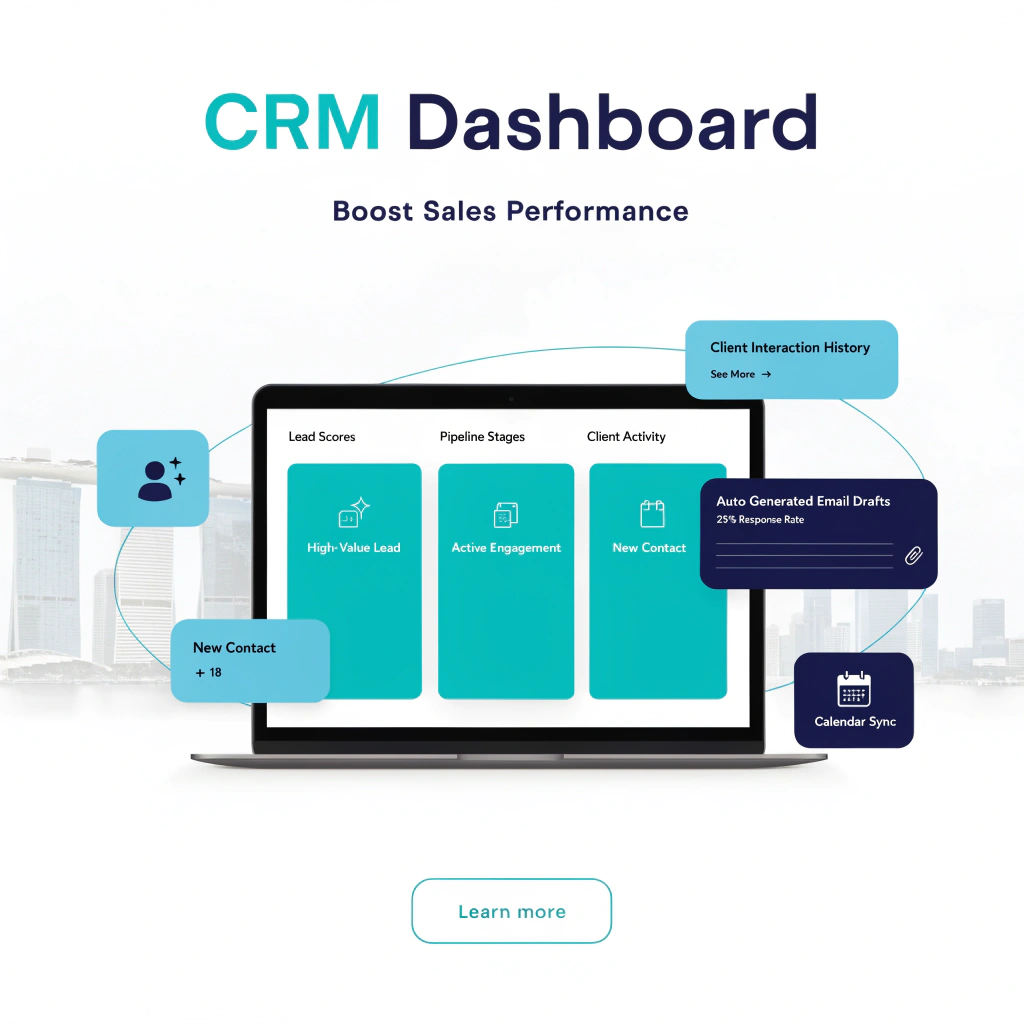
If your client relationship management system is still a spreadsheet — or a CRM platform that nobody actually uses — you’re not alone.
Most Singapore SMEs set up a CRM in a burst of optimism, enter data for two weeks, then slowly revert to WhatsApp threads and sticky notes. The tool becomes a graveyard of half-updated contacts and overdue follow-up tasks.
Here’s the problem: it’s not a discipline issue. It’s a design issue. Traditional CRM tools were built for large sales teams with dedicated ops staff. They were never designed for lean SME teams juggling ten roles at once.
AI-powered CRM tools change that equation. Not because they’re smarter than your team — but because they do the parts nobody wants to do: logging calls, drafting follow-up emails, scoring which leads are worth chasing, flagging clients who’ve gone quiet. The admin disappears. What’s left is the actual relationship work.
This post covers what AI CRM actually does (versus the hype), which tools are worth considering for Singapore SMEs, and how to get started without a six-month implementation project.
What Is AI CRM — and What Does It Actually Do?
An AI-powered CRM is a client relationship management platform that uses machine learning and automation to reduce the manual work of tracking, managing, and following up with clients and leads.
That sounds abstract. Here’s what it looks like in practice:
Automatic data entry. AI CRM platforms like HubSpot and Salesforce Einstein can listen to sales calls, read emails, and log contact details without anyone typing a single thing. For a five-person SME sales team, this alone recovers 45–60 minutes per rep per day.
Lead scoring. Instead of guessing which leads to prioritise, AI models score your pipeline based on engagement signals — email opens, website visits, call history, response speed. The leads most likely to convert rise to the top automatically.
Follow-up drafting. AI drafts follow-up emails based on call summaries or previous conversations. Your rep reviews, edits where needed, and sends. What used to take 20 minutes takes 3.
Churn prediction. For clients already in your system, AI flags accounts that are going quiet — fewer logins, lower engagement, unanswered emails — before they churn. You get the alert early enough to do something about it.
Conversation intelligence. Tools like Gong or Fireflies.ai integrate with CRM to transcribe client calls, extract action items, and summarise what was discussed and what was promised. No more “wait, what did we agree on?”
The honest version: AI CRM isn’t magic. It still needs clean data to work well. If your existing contact records are a mess, the AI will confidently surface the wrong insights. Garbage in, garbage out — just faster.
Why Singapore SMEs Specifically Struggle with CRM
Most CRM statistics you’ll find are from US or European enterprise contexts. The Singapore SME reality is different.
Here’s what tends to happen locally:
The team is tiny. Many Singapore SMEs run sales and operations with three to eight people. There’s no dedicated CRM admin, no sales ops manager, no RevOps team. The person supposed to update the CRM is the same person doing the sales calls, writing the proposals, and answering WhatsApp at 11pm.
Clients expect fast responses. Singapore buyers — whether B2B or retail — expect replies within the hour. Manual CRM workflows don’t keep up. AI automation does.
Government funding exists but isn’t used. The SkillsFuture Enterprise Credit (SFEC) gives eligible SMEs up to S$10,000 in credits for workforce training and business transformation — and it expires in June 2026. Most SME owners we speak to either don’t know it exists or think it’s too complicated to claim. It isn’t.
Workflow software adoption is low. According to IMDA’s 2024 SME Digital Commerce Report, fewer than 40% of Singapore SMEs have adopted formal CRM or workflow automation tools. The gap between knowing you need it and actually doing it remains wide.
AI CRM lowers the barrier. Less setup, less ongoing admin, more value from day one.
The 5 Best AI CRM Tools for Singapore SMEs in 2026
No single tool is right for everyone. What follows is an honest breakdown — not a sponsored list — of platforms that make sense for different SME contexts in Singapore.
1. Engages.ai (for SMEs that want CRM + marketing automation built for growth)
Best for: SMEs that need sales pipeline, automated follow-ups, and client communication in one system — without stitching together four separate tools
Engages.ai is QD Academy’s recommended AI CRM platform for Singapore SMEs. It combines contact management, pipeline tracking, email and SMS automation, AI-drafted follow-ups, appointment booking, and conversation AI in a single system — eliminating the need for separate tools for each function.
Where most CRM platforms are built for large enterprise teams and scaled down awkwardly for SMEs, Engages.ai is designed from the ground up for lean, growth-focused businesses. The AI layer drafts client responses, automates follow-up sequences based on lead behaviour, and flags deals that have stalled — so nothing falls through the cracks when your team is stretched.
For SMEs currently paying separately for a CRM, an email marketing tool, a booking system, and a chatbot, the consolidation alone often justifies the switch.
The honest note: Like any all-in-one platform, the breadth means some individual features won’t be as deep as a specialist tool. If you need enterprise-grade analytics, you’ll eventually want supplementary tools. But for most Singapore SMEs at the growth stage, Engages.ai covers 90% of what’s needed in one place.
Singapore note: Engages.ai is built with Singapore SMEs in mind — local support, SGD pricing, and practical onboarding. QD Academy uses it internally and trains teams on it as part of our AI courses.
2. HubSpot CRM (Free tier + AI add-ons)
Best for: SMEs just starting to formalise their sales process
HubSpot’s free CRM is genuinely free — not a 14-day trial, not a feature-crippled demo. You get contact management, deal pipelines, email tracking, and basic meeting scheduling at no cost.
The AI layer (in paid tiers) adds email drafting, conversation summaries, and predictive lead scoring. For SMEs moving off spreadsheets, HubSpot’s free tier is the lowest-friction entry point available.
The catch: Once you want marketing automation, the pricing jumps quickly. HubSpot’s paid tiers are designed for growth-stage companies, not lean SME teams watching every dollar.
Singapore note: HubSpot is widely used in Singapore’s startup and digital marketing agency community. Finding someone who knows it isn’t hard.
3. Zoho CRM with Zia AI
Best for: SMEs that want an affordable all-in-one platform
Zoho CRM is significantly cheaper than HubSpot’s paid plans, and Zia — Zoho’s AI assistant — does a solid job of flagging anomalies in your pipeline, predicting deal outcomes, and recommending the best time to contact a lead based on their historical engagement patterns.
Zoho’s SME pricing starts from around S$25/user/month, which makes it accessible for teams of five or fewer. The interface isn’t as polished as HubSpot, but the functional depth is real.
Singapore note: Zoho is an Indian company with strong regional support infrastructure across Southeast Asia. GST invoicing and SGD pricing are standard.
4. Salesforce Starter (formerly Essentials)
Best for: SMEs planning to scale and wanting enterprise-grade infrastructure early
Salesforce’s entry-level tier — now repackaged as Salesforce Starter — brings Einstein AI features to smaller teams at a lower price point. If you’re expecting to grow to 20+ staff within two years, starting on Salesforce means you won’t need to migrate later.
The AI features are impressive: predictive scoring, email sentiment analysis, automated activity capture. The setup complexity is also real. Budget time for onboarding.
Singapore note: Salesforce has a local Singapore office and active user community. IMDA’s SMEs Go Digital programme lists pre-approved digital solutions — worth checking for any available government co-funding.
5. Fireflies.ai (for conversation intelligence)
Best for: SMEs doing frequent client calls and losing track of commitments
Fireflies isn’t a full CRM — it’s a meeting intelligence layer that plugs into your existing CRM. It joins your Zoom, Teams, or Google Meet calls, transcribes everything, extracts action items, and pushes summaries directly into HubSpot, Salesforce, or Zoho.
For professional services firms, consultancies, and sales-heavy businesses where every client conversation matters, this is one of the highest-ROI tools available. Pricing starts at US$10/user/month.
The practical impact: no more “let me check my notes” in follow-up emails. The AI has the notes.
How to Actually Implement AI CRM Without a Six-Month Project
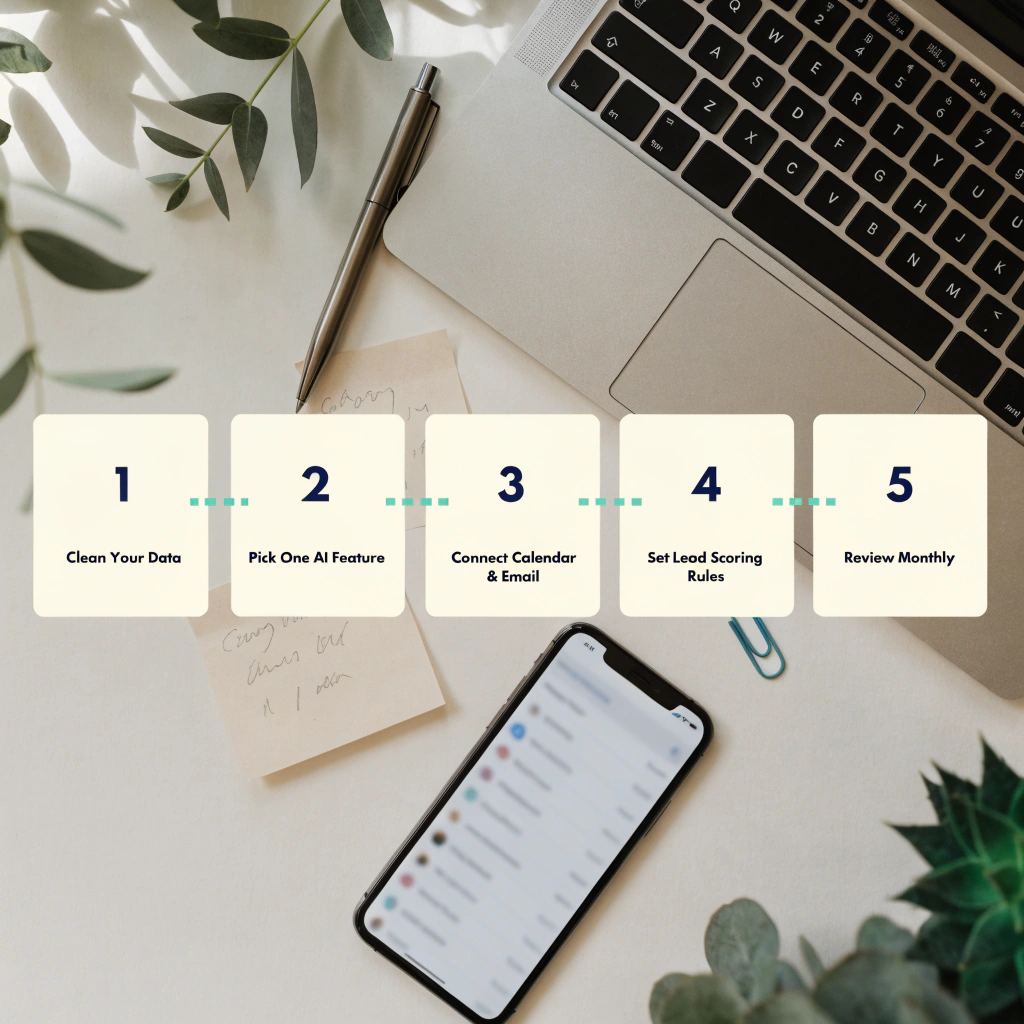
Most SME AI CRM implementation stories go wrong in the same way: too many features turned on at once, not enough team buy-in, data that was never cleaned before migration.
Here’s a simpler approach that works:
Step 1: Clean your contact data first (Week 1)
Before touching any AI tool, export your existing contacts — wherever they live — and run a basic clean-up. Remove duplicates, fill in missing company names, standardise how you’ve been recording phone numbers. AI scoring tools are only as good as the data underneath them.
This isn’t glamorous work. But it’s the difference between an AI that surfaces useful insights and one that confidently tells you the wrong thing.
Step 2: Choose one AI feature to turn on first (Week 2)
Don’t try to automate everything simultaneously. Pick the single highest-pain point and start there.
For most SMEs, that’s follow-up automation — because it’s the task most likely to fall through the cracks, and the one with the clearest revenue impact. Set up AI-drafted follow-up templates for your three most common scenarios (post-meeting, post-proposal, no-reply after 7 days). Review every draft before it sends, at least initially.
Step 3: Integrate with your calendar and email (Week 2–3)
The biggest unlock for AI CRM isn’t the CRM itself — it’s connecting it to where work actually happens. Sync your Google Calendar or Outlook so meeting data flows automatically. Connect your email so client interactions are logged without manual entry.
Once this is in place, the CRM updates itself. That’s the moment most teams stop resisting it.
Step 4: Set up lead scoring rules (Week 4)
After 30 days of clean data flowing in, you have enough signal to set meaningful lead scoring rules. Define what “hot lead” looks like for your business: opened three emails? Visited your pricing page twice? Replied within 24 hours? The AI can score and surface those leads automatically from then on.
Step 5: Review and adjust monthly
AI CRM isn’t set-and-forget. Check your pipeline health once a month: are the leads it’s flagging actually converting? Are the churn alerts firing early enough to act? Adjust the scoring rules as you learn what actually predicts a deal closing in your specific context.
Understanding the Customer Journey Before Automating It
Here’s something that catches SMEs out: they implement AI CRM tools before they’ve mapped their customer journey clearly. The result is automation that moves clients efficiently through the wrong process.
A CRM automates your sales and retention workflow. If that workflow is unclear — if you don’t know what happens between “first contact” and “signed contract,” or between “onboarding” and “renewal” — then automating it just makes the confusion faster.
The most effective way to approach this is to map your customer journey first, identify the moments where leads go cold or clients churn, and then automate the touchpoints that matter most.
This is exactly what QD Academy’s Developing an Effective Customer Journey Map using AI and Automation course on the 18th-20th May covers — using AI tools to build and analyse your customer journey with real data, not assumptions. The course runs as a 3-day intensive with SkillsFuture subsidies available.
What About SkillsFuture and SFEC Funding?
If you’re a Singapore SME exploring AI tools and training, two funding mechanisms are worth knowing:
SkillsFuture Enterprise Credit (SFEC) provides eligible SMEs with S$10,000 in credits to offset costs for workforce training and business transformation. This includes approved AI training programmes. SFEC expires June 2026 — if you haven’t used it, now is the time. Check eligibility and claim via the Enterprise Development Grant portal.
SkillsFuture Credit (for individual employees) can be used toward AI upskilling courses, including QD Academy programmes. Subsidies through SSG can cover up to 90% of course fees for eligible Singaporeans.
For SME owners thinking about equipping their teams with practical AI skills — not just CRM tools, but the underlying knowledge to use them well — this funding makes the investment substantially lower than the list price suggests.
Frequently Asked Questions
What is an AI-powered CRM?
An AI-powered CRM is a client relationship management system that uses machine learning to automate manual tasks like data entry, follow-up email drafting, lead scoring, and churn prediction. Unlike traditional CRMs, which require users to manually log every interaction, AI CRM tools capture and process client data automatically — reducing admin time and helping sales teams focus on actual selling.
Which CRM is best for a small business in Singapore?
For most Singapore SMEs starting from scratch, HubSpot’s free tier is the lowest-friction entry point. For teams that want more affordable paid features, Zoho CRM with Zia AI is strong value. If you’re in marketing, coaching, or professional services and need CRM plus marketing automation combined, GoHighLevel is worth evaluating. The right choice depends on your team size, current tech stack, and how quickly you expect to scale.
Can AI CRM replace my sales team?
No — and any vendor that implies otherwise is overselling. AI CRM handles the admin and pattern recognition that bogs salespeople down. It can draft emails, score leads, and flag at-risk accounts. What it can’t do is build trust, handle complex negotiations, read the room in a client meeting, or do the human work that actually closes deals in relationship-driven markets like Singapore. Think of it as a support system for your team, not a replacement.
Is AI CRM expensive for SMEs?
Less than most people assume. HubSpot’s CRM is free. Zoho starts at around S$25/user/month. With SFEC and SkillsFuture subsidies, the training costs to learn how to use these tools effectively can be significantly offset. The bigger cost for most SMEs isn’t the software — it’s the time to set it up properly. Budget four to six weeks for a realistic implementation, not four to six days.
How does AI CRM connect to customer journey mapping?
Your CRM captures data at every touchpoint of the client relationship — first inquiry, proposal, onboarding, renewal, or churn. AI CRM tools can surface patterns across that data: where leads tend to go cold, where clients disengage, what your highest-value clients have in common. But to use that data well, you need a clear map of your intended customer journey first. Many Singapore SMEs start with AI CRM tools and then realise they need to do the journey mapping work that should have come earlier.
What’s the difference between a CRM and workflow automation tools?
A CRM focuses specifically on managing client and prospect relationships — tracking contacts, deals, communications, and revenue pipeline. Workflow automation tools (like Zapier, Make, or n8n) connect different apps and automate multi-step processes across your business — not just sales. Many SMEs use both: a CRM for client relationship management and workflow automation tools to connect their CRM with the rest of their business tools (accounting, project management, marketing).
The Bottom Line
AI CRM isn’t a silver bullet. But for Singapore SMEs running lean teams and losing deals because follow-ups fall through cracks — or losing clients because nobody noticed they’d gone quiet — it’s one of the highest-return investments available right now.
Start simple. Clean your data. Turn on one AI feature. Connect your calendar and email. Then build from there.
And if you want to understand your customer journey well enough to automate it intelligently — rather than just automate the chaos faster — that’s worth doing first.
Ready to build AI skills your team can actually use? Explore QD Academy’s AI training courses — SkillsFuture-claimable, practical, and built for Singapore professionals and SMEs. WhatsApp us at +65 8986 6799 to find out which programme fits your team.