
There is a version of this conversation that starts with buzzwords — “future of work,” “digital transformation,” “the AI revolution.” You’ve heard it. You’ve probably ignored it.
Here’s the version that actually matters: in 2026, Singapore employers are quietly dividing job candidates into two camps. Camp one knows how to use AI tools. Camp two knows how to use AI tools and can lead, communicate, and read a room. Camp two gets hired first, promoted faster, and trusted with more.
This isn’t a prediction. It’s already showing up in hiring data, career counselling conversations, and the SkillsFuture Singapore framework, which has explicitly expanded its focus to include both technical AI capabilities and essential human skills — because the data showed both were needed together.
If you’re exploring a career change, considering a mid-career switch in Singapore, or just trying to stay ahead in your current role, understanding why the combination matters — and what to actually do about it — is the most useful thing you can read today.
What’s Actually Happening in the Singapore Job Market
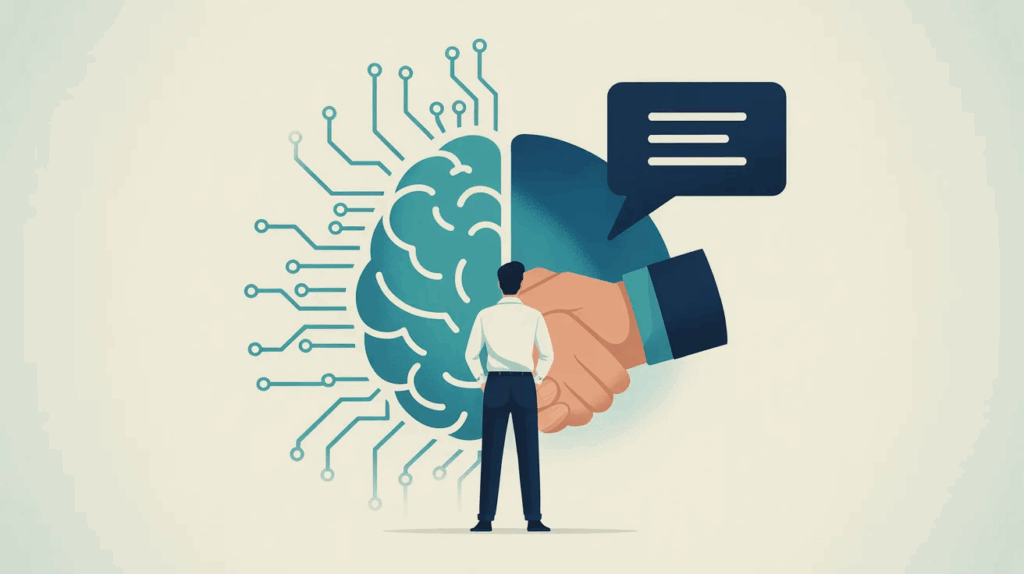
Spend five minutes on any Singapore job board and a pattern emerges. “AI proficiency preferred.” “Familiarity with automation tools.” “Data literacy required.” These phrases are now appearing in job descriptions for roles that, two years ago, mentioned nothing about technology at all — hospitality team leaders, marketing coordinators, HR executives, operations managers.
The Singapore National AI Strategy 2.0 didn’t happen in a vacuum. It came with workforce implications. As Singapore moves toward becoming an AI-ready economy, the expectation is shifting: digital fluency is no longer a bonus for PMET roles. It’s a baseline.
But here’s what the job postings don’t say explicitly: the candidates who are landing these roles aren’t the ones who took a crash course in ChatGPT and called it done. They’re the ones who can explain an AI-generated output to a sceptical client, manage a team through a workflow overhaul, and hold a difficult conversation about change without losing the room.
Those are soft skills. And they are rarer than people think.
A 2024 LinkedIn Workforce Report found that communication, leadership, and adaptability were among the top skills hiring managers said were hardest to find — in the same period when AI tool proficiency was exploding. The supply of technical AI learners grew. The supply of people who could do something useful with those skills in a team context did not keep pace.
This is the gap. And in Singapore’s tight, high-expectation job market, closing that gap is what a career change or mid-career switch should actually be designed to do.
Why AI Skills Alone Aren’t Enough
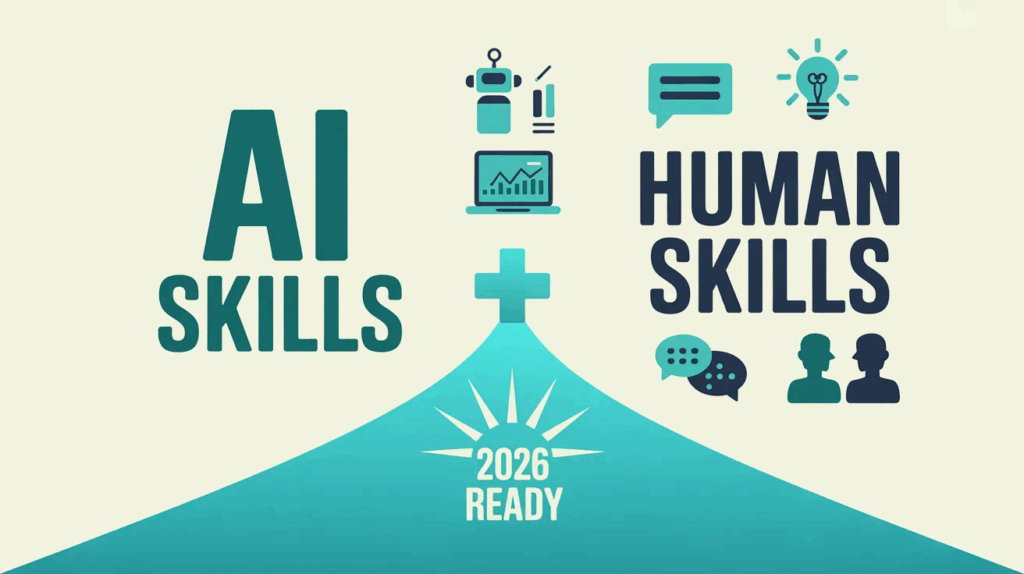
Let’s be direct about something: if you complete an AI course and stop there, you’re going to be better than you were — but not as strong as you could be.
AI tools are powerful precisely because they amplify whoever is using them. A clear communicator who uses AI writes better and faster than before. A strong leader who uses AI makes decisions with more data and less guesswork. A sales professional who uses AI builds better pipelines and closes more consistently.
But here’s the reverse: a poor communicator using AI produces polished-looking content that still misses the point. A manager with no self-awareness using AI dashboards still makes the same reactive, ego-driven decisions — just with better charts.
The World Economic Forum’s Future of Jobs Report 2025 is clear on this. The top skills employers expect to gain importance through 2030 include analytical thinking and creative thinking — but also resilience, leadership, social influence, and motivation. Technical skills account for fewer than half the skills flagged as critical.
This is not a soft argument for soft skills. It is a structural reality of how work actually happens: in teams, in conversations, in negotiations, in moments where someone needs to make a call under pressure and bring others along.
AI makes the technical parts faster. It doesn’t make the human parts easier. It makes them more important — because when everyone has access to similar tools, what differentiates you is how you show up.
The Self-Awareness Layer Nobody Talks About
Here’s the piece that gets left out of most career development conversations: before you can lead with AI, you need to understand how you lead.
This is where frameworks like the Enneagram become genuinely practical rather than just interesting. The Enneagram isn’t a personality quiz in the “which Disney character are you” sense. It’s a system for understanding your core motivations, your default responses under pressure, and the patterns that show up when you’re stressed, uncertain, or dealing with conflict.
For service leaders and hospitality professionals, this matters in a very specific way. In high-service environments, team dynamics are constant, customer expectations are non-negotiable, and the pressure is relentless. A team leader who doesn’t understand their own triggers — and the triggers of their team — is going to misread situations, create friction, and lose people.
Add AI tools into that environment and the stakes go up. Automated scheduling, AI-driven customer feedback analysis, chatbot-assisted service — these tools change how work flows. Leaders who can navigate that change while keeping their teams stable and motivated are the ones who thrive. Leaders who can’t become bottlenecks, or worse, sources of resistance that slow the whole operation down.
Self-awareness isn’t a nice-to-have for service leadership. It’s the operating system everything else runs on.
What a Mid-Career Switch Actually Requires in 2026
For mid-career professionals — broadly, those who’ve been working for 8 to 20 years — the combination of soft and AI skills isn’t just a performance edge. It’s often the difference between a career transition that works and one that doesn’t.
Here’s why. When you’re making a career change or a mid-career switch in Singapore, employers know you’re coming from outside the role. They’re not expecting perfection. What they are evaluating is: can this person learn, adapt, and bring something a junior hire can’t? The answer, when it’s yes, is almost always a combination of mature human skills — judgment, communication, leadership instinct — and demonstrated willingness to embrace new tools and ways of working.
The Career Conversion Programme (CCP), supported by Workforce Singapore under SSG (SkillsFuture Singapore), is specifically designed around this reality. CCPs exist because experienced professionals have real value — they just sometimes need a bridge into a new role or sector. The programme provides salary support to employers and structured training to individuals, making the transition lower-risk for both sides.
Critically, CCP training typically includes both technical upskilling and professional development components — because Workforce Singapore and employers both understand that skills training without leadership and communication development produces people who know the tools but can’t apply them in a team context.
For those aged 40 and above, the Mid-Career Enhanced Subsidy (MCES) increases the funding available for courses — up to 90% in some cases — which significantly reduces the financial barrier to taking this kind of dual-track development seriously.
If you’re currently navigating a career change Singapore, or exploring a mid-career switch, this subsidy landscape is worth understanding before you choose which courses to invest in.
How This Plays Out in Hospitality and Service Leadership
Let’s get specific. Hospitality is one of Singapore’s most significant employment sectors, and also one of the most affected by the intersection of AI tools and human service expectations.
Front-of-house and team leadership roles in hotels, F&B, and service industries are seeing rapid integration of operational technology — AI-driven booking systems, automated feedback collection, digital service quality monitoring, labour optimisation tools. The back end of service is being automated. The front end — the experience — remains stubbornly human.
What this creates is a leadership challenge that is, frankly, more complex than many leaders realise. You’re managing a team where some members feel threatened by the technology, others are excited but need guidance, and all of them are expected to deliver exceptional human experiences while working alongside systems they didn’t ask for and may not fully understand.
The leaders who handle this well are not necessarily the ones with the most technical knowledge. They are the ones who can hold conversations about change with honesty, who understand how their team members respond under pressure, and who can translate the purpose behind the technology into terms that motivate rather than threaten.
That’s Enneagram work. That’s leadership development. And it’s why pairing that kind of self-awareness training with AI literacy is particularly high-value for service industry professionals — not as two separate boxes to tick, but as a genuinely integrated way of developing.
Practical Steps: Building Both Skill Sets Without Burning Out
The good news: you don’t need to overhaul your life. You need a structured approach.
Step 1: Start with self-awareness. Before adding AI skills, understand your leadership patterns. Where do you default under pressure? How do you handle conflict? How do you come across to your team? Tools like the Enneagram give you this map — not to categorise you, but to give you something actionable to work with.
Step 2: Choose AI training that’s applied, not abstract. Courses that teach you to use specific AI tools for real work tasks — content creation, data analysis, customer journey mapping, sales automation — are more valuable than conceptual overviews. Look for SkillsFuture-approved AI courses that connect to your actual job function.
Step 3: Practise the combination. The real learning happens when you use an AI tool to prepare for a difficult conversation, or when you apply your Enneagram knowledge to understand why a team member is resistant to a new workflow. The integration is the point.
Step 4: Use the funding available. Between SkillsFuture Credit, UTAP (Union Training Assistance Programme), SFEC (SkillsFuture Enterprise Credit for employers), and MCES for those 40 and above, the Singapore government has built a genuinely supportive training environment. Use it. The subsidies exist for exactly this kind of upskilling.
Step 5: Don’t wait for the “right time.” This is the pattern that derails mid-career professionals more than anything else. The right time is when there is still runway — before a redundancy, before a forced pivot, while you still have the energy and the options.
Why This Combination Produces Better Leaders, Not Just Better Workers
There’s a reason this post isn’t titled “Why AI Tools Will Make You Better at Your Job.” That’s too small a frame.
The combination of AI skills and soft skills — specifically self-awareness, communication, and leadership capability — doesn’t just make you more employable. It changes how you work. It changes how you lead. It changes what you’re capable of.
When you understand yourself well enough to manage your reactions, you make better decisions. When you can communicate clearly in high-pressure situations, you create stability for your team. When you know how to use AI to remove friction from your workflow, you have more energy for the work that actually requires you.
This is what QD Academy is designed to produce. Not just professionals who can tick a box that says “AI-trained” — but people who are genuinely better at their work because they’ve developed both dimensions of what it means to lead in 2026.
The clients we work with — service leaders, hospitality managers, sales professionals, SME founders — almost uniformly say the same thing after going through both tracks of training: “I wish I’d done this earlier.” Not because the tools are magic, but because the combination of clarity about themselves and capability with their tools changes how they show up every day.
FAQ
Is it better to learn AI skills or soft skills first?
There’s no universal answer, but for most mid-career professionals, starting with self-awareness work creates a better foundation. When you understand your own patterns — how you communicate, how you respond to stress, what triggers you — you’re better positioned to learn and apply new tools effectively. The Enneagram framework, for example, can be a useful starting point before layering in AI skill development.
What SkillsFuture subsidies are available for leadership and AI training in Singapore?
Singaporean citizens and PRs can use SkillsFuture Credit to offset course fees. Those aged 40 and above qualify for the Mid-Career Enhanced Subsidy, which can cover up to 90% of course fees at SSG-approved providers. NTUC members can tap UTAP for an additional rebate. Employers can access SkillsFuture Enterprise Credit (SFEC) to fund staff training. Check the MySkillsFuture portal for current subsidy rates.
What is the Career Conversion Programme and who qualifies?
The Career Conversion Programme (CCP) helps mid-career professionals switch to new roles or sectors. It provides salary support to employers who hire and train CCP candidates, and structured reskilling pathways for the individual. Generally open to Singaporeans and PRs who are PMETs looking to pivot. QD Academy is a CCP-supported training provider for several AI and HR-related roles.
Can service industry leaders benefit from AI training, or is it more relevant to tech roles?
AI training is highly relevant for service industry professionals — arguably more so in some ways, because the operational environment is already changing around them. AI tools for scheduling, customer feedback, service quality monitoring, and team management are being adopted across hotels, F&B, and retail. Leaders who understand both the tools and how to bring their teams through change are significantly more effective than those who have one without the other.
What is the Enneagram and why is it useful for work?
The Enneagram is a personality framework that maps nine core motivational types — useful not for labelling people but for understanding how different personalities respond to stress, pressure, conflict, and change. In a work context, it helps leaders understand their own tendencies and communicate more effectively with team members who think and respond differently. At QD Academy, we use it as a practical leadership development tool within our service leadership programmes.
How do I find courses in Singapore that cover both AI and soft skills?
Look for SkillsFuture-approved providers that offer integrated programmes — not just standalone AI tools training or soft skills workshops, but courses that connect both. QD Academy’s programmes are designed around this integration. You can also search the MySkillsFuture portal using terms like “AI productivity,” “leadership,” or “career conversion” to find funded options.
Ready to Build Both?
QD Academy’s Enneagram Leadership for Service Professionals programme is designed for exactly this moment — hospitality and service leaders who want to lead with greater self-awareness and integrate AI tools into how their teams operate.
Next run: 9th July – 10th July 2026
SkillsFuture-claimable | Subsidies available | Limited seats
📩 Register at qdacademy.com.sg or WhatsApp +65 8986 6799 to check availability.