

QD Academy

SkillsFuture Credit 2026: Step-by-Step Guide to Claiming Your AI Training Subsidy


Most Singaporeans with SkillsFuture Credit have never used it. Not because they don't want to but because nobody told them how, and the portal isn't exactly welcoming.
If you've been sitting on your credit wondering whether it works for AI courses (it does), whether you need to apply before some deadline (you might), or whether there's more subsidy on top (there is) — this guide walks you through the full picture, step by step.
This is written for working professionals, PMETs, and anyone considering an AI course in 2026 who wants to make the most of what the government is already giving them.
What Is SkillsFuture Credit — and How Much Do You Have?
SkillsFuture Credit is a funding scheme managed by SkillsFuture Singapore (SSG) that gives eligible Singaporeans a credit balance they can use to pay for approved training courses. It's not a reimbursement — you use it at the point of payment.
Here's the current credit structure as of 2026:
Base Credit: Every Singapore Citizen aged 25 and above received an initial S$500 credit. This is the original SkillsFuture Credit that has been around since 2016.
SkillsFuture Credit (Mid-Career) — One-Time Top-Up: Singaporeans aged 40 to 60 received a one-time top-up of S$4,000 in October 2020. This Mid-Career Enhanced Subsidy top-up was specifically to support mid-career professionals who want to pivot, upskill, or transition industries.
SkillsFuture Level-Up Programme (from May 2024): Under Budget 2024, the government introduced a new one-time S$4,000 SkillsFuture Credit top-up for all Singaporeans aged 40 and above, alongside a new Level-Up Programme with enhanced subsidies for selected full qualifications.
Before you do anything else: log into MySkillsFuture with your Singpass to check your balance. Many people are surprised by how much they still have.
Who Is Eligible for SkillsFuture Funding?
Singapore Citizens and PRs
For SkillsFuture Credit (Base):
Singapore Citizens aged 25 and above
Credit is not available to Singapore PRs for the base credit
For SSG Course Subsidies (separate from Credit): This is where PRs benefit too. SSG subsidies on course fees apply to both Singapore Citizens and Permanent Residents. A SkillsFuture Credit for PR arrangement does not exist for the credit balance itself, but PRs are still eligible for significant course fee subsidies — sometimes up to 70% — without needing the credit.
For Mid-Career Enhanced Subsidy (MCES):
Singapore Citizens aged 40 and above
Taking courses in eligible SSG-funded programmes
Subsidy can reach up to 90% of course fees for select programmes
If you've been wondering: does Singapore PR have SkillsFuture Credit? The short answer is no for the credit balance — but yes for subsidised course fees. The distinction matters when you're budgeting what you'll actually pay.
The Full Landscape of Subsidies Available in 2026

SkillsFuture Credit is just one layer. Here's the complete stack of funding available for AI training courses in Singapore:
1. SSG (SkillsFuture Singapore) Course Subsidies
SSG funding covers a baseline percentage of approved course fees. For most WSQ courses and SSG-approved programmes, the subsidy is:
Up to 70% for Singapore Citizens and PRs under 40
Up to 90% for Singapore Citizens aged 40 and above under the Mid-Career Enhanced Subsidy
This happens automatically when you enrol in an SSG-approved course — you don't need to apply separately. The course provider adjusts the price at checkout.
2. SkillsFuture Credit (Base + Top-Up)
On top of the SSG subsidy, eligible Singapore Citizens can use their SkillsFuture Credit to offset the remaining course fee (the "nett fee after subsidy"). So if a course costs S$800 and SSG subsidises 70%, your nett fee is S$240 — and you can use your Credit to pay that S$240.
3. SkillsFuture Enterprise Credit (SFEC)
If you're a business owner or HR manager sending employees for training, SFEC is specifically for companies. SkillsFuture Enterprise Credit gives eligible SMEs a one-time S$10,000 credit to cover up to 90% of out-of-pocket training costs per employee. This is separate from the individual SkillsFuture Credit and is claimed through the SkillsFuture Employer portal.
To check eligibility, your company must have contributed to the Skills Development Fund (SDF) and employed at least three Singapore Citizens or PRs.
4. UTAP (Union Training Assistance Programme)
If you're a NTUC member, UTAP provides an additional 50% subsidy on top of other funding — up to S$250 per year (or S$500 per year for members aged 40 and above). This means NTUC members effectively get an additional layer on top of SSG subsidies and Credit.
5. Absentee Payroll
For employer-sponsored training, companies can claim Absentee Payroll from SSG to offset the salary cost of employees attending training during work hours. The reimbursement is S$4.50 per hour for SMEs and S$7.50 per hour for non-SMEs, capped at 80% of hourly basic salary.
When you stack SSG subsidy + SFEC + UTAP + Absentee Payroll, the actual out-of-pocket cost for AI training can approach zero for the right profile of employer and employee.
Step-by-Step: How to Claim Your SkillsFuture Credit for an AI Course
Here's the exact process — no guesswork.

Step 1: Check Your Credit Balance
Go to MySkillsFuture.gov.sg and log in with Singpass. Your dashboard shows:
Your total credit balance
Any credits that have already been used
Expiry dates (see note below on the SkillsFuture Credit expiry date)
Step 2: Find an SSG-Approved AI Course
Not all AI courses qualify. The course must be listed on the MySkillsFuture course directory or be offered by an SSG-approved training provider.
When searching, filter by:
"SkillsFuture Credit Eligible" to find credit-eligible courses
Course category: Digital Literacy, Infocomm Technology, or Data Analytics
Delivery mode: Classroom / eLearning / Blended
Look for courses tagged with the SkillsFuture Skills Framework competencies, which indicates they're mapped to industry-relevant skills.
QD Academy's AI courses — including AI-Powered Productivity, Mastering AI for Sales Growth, and Developing an Effective Customer Journey Mapping with AI — are SkillsFuture Credit eligible. You can contact the team via WhatsApp at +65 8069 3194 to confirm eligible course codes before enrolling.
Step 3: Enrol and Select SkillsFuture Credit as Payment
When you enrol in a qualifying course, you'll typically be directed to a payment page where you can apply your Credit. For courses enrolled via the MySkillsFuture portal, the credit deduction happens automatically at checkout. For courses enrolled directly through the training provider, you submit a Credit claim through the MySkillsFuture portal after enrolment.
The process:
Log in to MySkillsFuture
Go to "Submit a Claim"
Select the course and training provider
Enter your enrolment confirmation number
Specify the amount to claim (up to your balance, up to the nett course fee)
Submit — approval typically takes 3–5 business days
Step 4: Complete the Course
Credit claims are disbursed to the training provider after course completion. You must attend at least 75% of the course hours to qualify. If you withdraw or miss too many sessions, the claim may be voided.
Step 5: Claim UTAP (If NTUC Member)
After completing the course, NTUC members submit a UTAP claim through the NTUC portal with proof of payment and attendance. This is a separate step from the SkillsFuture Credit claim.
SkillsFuture Credit Expiry — What You Need to Know
The SkillsFuture Credit expiry date is a question that causes a lot of confusion.
Here's the current position as of 2026:
The original S$500 base credit does not expire as long as you remain a Singapore Citizen.
The one-time top-up credits introduced under specific programmes may have separate expiry windows.
The current SFEC initiative expires in June 2026. Companies that haven't tapped their S$10,000 credit should act before the window closes 
To check your specific SkillsFuture Credit expiry date and breakdown, log into MySkillsFuture > "My Credit" > "View Credit History." Each credit tranche is listed with its expiry separately.
If you're concerned about your balance expiring, enrolling in an approved AI course is one of the fastest ways to put it to work — and AI training is one of the most future-relevant categories available.
Mid-Career Enhanced Subsidy: The Biggest Subsidy Most People Don't Know About
The SkillsFuture Mid-Career Enhanced Subsidy (MCES) is worth calling out separately because it's the most generous — and most underutilised — subsidy in the stack.
If you're a Singapore Citizen aged 40 and above, the MCES tops up your SSG subsidy to cover up to 90% of course fees for eligible programmes. This applies to a wide range of WSQ courses and full qualifications.
For a mid-career professional looking at an AI course priced at S$1,200, the maths looks like this:
Without MCES (citizen under 40)
With MCES (citizen 40+)
SSG subsidy: 70% = S$840 off
SSG + MCES: 90% = S$1,080 off
Nett fee: S$360
Nett fee: S$120
After Credit: Could be S$0
After Credit: S$0

The MCES applies automatically when you enrol in an eligible programme — you don't submit a separate application. Just confirm with the course provider that the course is MCES-eligible.
SkillsFuture Enterprise Credit (SFEC): For HR Teams and Business Owners
If you're responsible for training your team, SFEC works differently from individual Credit. Here's what to know:
Who qualifies:
Business entities with at least three Singapore Citizens or PRs on the payroll
Must have contributed to the Skills Development Fund (SDF) in the qualifying period
Check eligibility at the Enterprise Portal for Jobs and Skills
How much: S$10,000 one-time credit per company, covering up to 90% of out-of-pocket qualifying training costs.
What it covers: Course fees for eligible programmes, productivity tools, job redesign consultancies, and select other workforce development costs.
How to claim: Through the SkillsFuture Employer portal, not through MySkillsFuture. Claims are submitted after payment and approved by SSG.
For SME owners sending teams through AI training — whether for Sales, Productivity, or Customer Journey Mapping — SFEC can significantly reduce the net cost per head.
Common Questions About SkillsFuture Credit
Can I use SkillsFuture Credit for online AI courses?
Yes — many online AI courses on the MySkillsFuture directory are credit-eligible. Look for the "SkillsFuture Credit Eligible" tag in the search filters. The mode of delivery (online vs. classroom) doesn't affect credit eligibility; what matters is that the course is SSG-approved.
Can I use SkillsFuture Credit for multiple courses?
Yes. As long as you have a credit balance remaining, you can use it across multiple courses. There's no rule limiting you to one course per year.
What happens to my credit if I change jobs or leave the workforce?
Your SkillsFuture Credit is tied to your Singpass identity, not your employer. It stays with you regardless of employment status. In fact, upskilling during a career transition is exactly what it's designed for.
Does my company need to approve my use of SkillsFuture Credit?
No. Individual Credit is yours to use independently. If your employer is sponsoring training separately, they would use SFEC — but your personal Credit is always under your own control.
How do I check if a specific QD Academy course is SkillsFuture Credit eligible?
The quickest way is to reach out directly via WhatsApp at +65 8847 8417 and ask for the course code and eligibility status. You can also search by provider name on MySkillsFuture.
What Budget 2026 Adds to the Picture
Budget 2026 introduced a significant new initiative for AI training: eligible Singaporeans who enrol in selected AI courses can access six months of free premium AI tools — including tools like Microsoft Copilot and other productivity platforms — as part of their course enrolment.
This means when you use your SkillsFuture Credit for a qualifying AI course in 2026, you may also unlock access to premium AI tool subscriptions at no additional cost. The eligibility criteria and list of qualifying courses are updated on the MySkillsFuture portal.
Combined with the SSG subsidy, SkillsFuture Credit, and MCES, the 2026 landscape makes AI upskilling more accessible than it's ever been.
Which AI Courses Should You Use Your Credit For?
The answer depends on what you need. Here's a practical frame:
If you're in sales or business development and want to close more deals, build a better pipeline, and use AI to qualify leads faster — the AI for Sales course is designed specifically for that outcome. Two days, practical, and SkillsFuture Credit eligible.
If you're a professional drowning in admin, emails, and meetings — the AI-Powered Productivity course teaches how to use AI tools to automate the repeatable parts of your day, from meeting notes to content drafts. Consistently one of the most attended courses we run.
If you're in marketing or work with customer-facing teams — Customer Journey Mapping with AI helps you use real data and AI to understand where customers drop off and what actually drives conversion.
All QD Academy courses are SkillsFuture Credit eligible, subsidised by SSG, and delivered by practitioners — not lecturers reading slides. To find out which course fits your situation, message the team at +65 8847 8417 on WhatsApp and get a straight answer.
The Bottom Line
SkillsFuture Credit isn't complicated once you understand the layers. For most Singaporeans looking at AI training in 2026:
SSG subsidises 70–90% of the course fee automatically
Your Credit balance covers most or all of the remainder
MCES, SFEC, UTAP, and Absentee Payroll can each add more
Budget 2026 adds six months of free premium AI tools for eligible enrolments
The gap between what you think AI training costs and what you'll actually pay is usually much larger than people expect. The main cost is time — not money.
If your credit is sitting unused, it doesn't grow. It's there to be spent on your career. Now is a reasonable time to spend it.

Most Singaporeans with SkillsFuture Credit have never used it. Not because they don’t want to but because nobody told them how, and the portal isn’t exactly welcoming.

If you’ve been sitting on your credit wondering whether it works for AI courses (it does), whether you need to apply before some deadline (you might), or whether there’s more subsidy on top (there is) — this guide walks you through the full picture, step by step.

This is written for working professionals, PMETs, and anyone considering an AI course in 2026 who wants to make the most of what the government is already giving them.

What Is SkillsFuture Credit — and How Much Do You Have?

SkillsFuture Credit is a funding scheme managed by SkillsFuture Singapore (SSG) that gives eligible Singaporeans a credit balance they can use to pay for approved training courses. It’s not a reimbursement — you use it at the point of payment.

Here’s the current credit structure as of 2026:

Base Credit: Every Singapore Citizen aged 25 and above received an initial S$500 credit. This is the original SkillsFuture Credit that has been around since 2016.

SkillsFuture Credit (Mid-Career) — One-Time Top-Up: Singaporeans aged 40 to 60 received a one-time top-up of S$4,000 in October 2020. This Mid-Career Enhanced Subsidy top-up was specifically to support mid-career professionals who want to pivot, upskill, or transition industries.

SkillsFuture Level-Up Programme (from May 2024): Under Budget 2024, the government introduced a new one-time S$4,000 SkillsFuture Credit top-up for all Singaporeans aged 40 and above, alongside a new Level-Up Programme with enhanced subsidies for selected full qualifications.

Before you do anything else: log into MySkillsFuture with your Singpass to check your balance. Many people are surprised by how much they still have.

Who Is Eligible for SkillsFuture Funding?

Singapore Citizens and PRs

For SkillsFuture Credit (Base):

  • Singapore Citizens aged 25 and above
  • Credit is not available to Singapore PRs for the base credit

For SSG Course Subsidies (separate from Credit): This is where PRs benefit too. SSG subsidies on course fees apply to both Singapore Citizens and Permanent Residents. A SkillsFuture Credit for PR arrangement does not exist for the credit balance itself, but PRs are still eligible for significant course fee subsidies — sometimes up to 70% — without needing the credit.

For Mid-Career Enhanced Subsidy (MCES):

  • Singapore Citizens aged 40 and above
  • Taking courses in eligible SSG-funded programmes
  • Subsidy can reach up to 90% of course fees for select programmes

If you’ve been wondering: does Singapore PR have SkillsFuture Credit? The short answer is no for the credit balance — but yes for subsidised course fees. The distinction matters when you’re budgeting what you’ll actually pay.

The Full Landscape of Subsidies Available in 2026
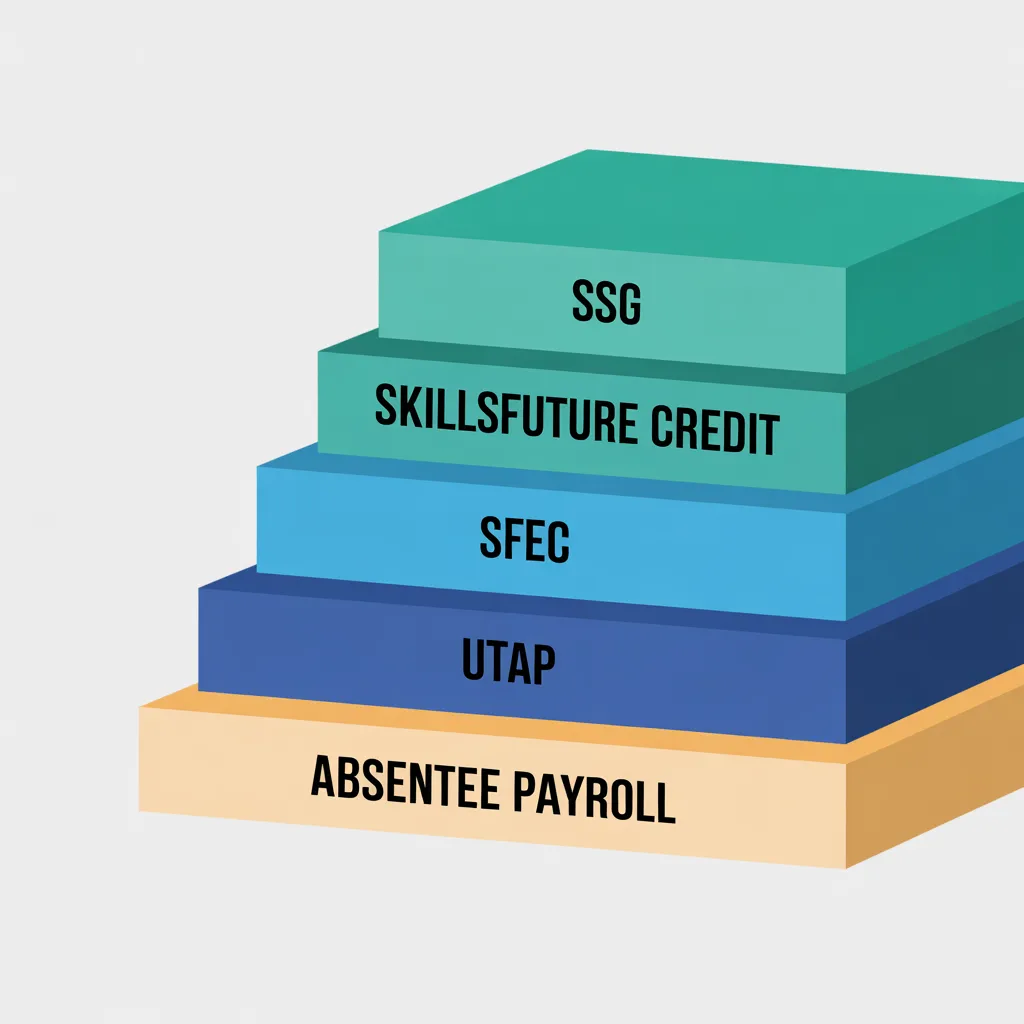
Diagram showing full stack of Singapore training subsidies — SSG, SkillsFuture Credit, SFEC, UTAP, and Absentee Payroll
Filename: skillsfuture-subsidy-stack-singapore-2026.jpg

SkillsFuture Credit is just one layer. Here’s the complete stack of funding available for AI training courses in Singapore:

1. SSG (SkillsFuture Singapore) Course Subsidies

SSG funding covers a baseline percentage of approved course fees. For most WSQ courses and SSG-approved programmes, the subsidy is:

  • Up to 70% for Singapore Citizens and PRs under 40
  • Up to 90% for Singapore Citizens aged 40 and above under the Mid-Career Enhanced Subsidy

This happens automatically when you enrol in an SSG-approved course — you don’t need to apply separately. The course provider adjusts the price at checkout.

2. SkillsFuture Credit (Base + Top-Up)

On top of the SSG subsidy, eligible Singapore Citizens can use their SkillsFuture Credit to offset the remaining course fee (the “nett fee after subsidy”). So if a course costs S$800 and SSG subsidises 70%, your nett fee is S$240 — and you can use your Credit to pay that S$240.

3. SkillsFuture Enterprise Credit (SFEC)

If you’re a business owner or HR manager sending employees for training, SFEC is specifically for companies. SkillsFuture Enterprise Credit gives eligible SMEs a one-time S$10,000 credit to cover up to 90% of out-of-pocket training costs per employee. This is separate from the individual SkillsFuture Credit and is claimed through the SkillsFuture Employer portal.

To check eligibility, your company must have contributed to the Skills Development Fund (SDF) and employed at least three Singapore Citizens or PRs.

4. UTAP (Union Training Assistance Programme)

If you’re a NTUC member, UTAP provides an additional 50% subsidy on top of other funding — up to S$250 per year (or S$500 per year for members aged 40 and above). This means NTUC members effectively get an additional layer on top of SSG subsidies and Credit.

5. Absentee Payroll

For employer-sponsored training, companies can claim Absentee Payroll from SSG to offset the salary cost of employees attending training during work hours. The reimbursement is S$4.50 per hour for SMEs and S$7.50 per hour for non-SMEs, capped at 80% of hourly basic salary.

When you stack SSG subsidy + SFEC + UTAP + Absentee Payroll, the actual out-of-pocket cost for AI training can approach zero for the right profile of employer and employee.

Step-by-Step: How to Claim Your SkillsFuture Credit for an AI Course

Here’s the exact process — no guesswork.

Step-by-step process of claiming SkillsFuture Credit online using MySkillsFuture portal

Step 1: Check Your Credit Balance

Go to MySkillsFuture.gov.sg and log in with Singpass. Your dashboard shows:

  • Your total credit balance
  • Any credits that have already been used
  • Expiry dates (see note below on the SkillsFuture Credit expiry date)

Step 2: Find an SSG-Approved AI Course

Not all AI courses qualify. The course must be listed on the MySkillsFuture course directory or be offered by an SSG-approved training provider.

When searching, filter by:

  • “SkillsFuture Credit Eligible” to find credit-eligible courses
  • Course category: Digital Literacy, Infocomm Technology, or Data Analytics
  • Delivery mode: Classroom / eLearning / Blended

Look for courses tagged with the SkillsFuture Skills Framework competencies, which indicates they’re mapped to industry-relevant skills.

QD Academy’s AI courses — including AI-Powered Productivity, Mastering AI for Sales Growth, and Developing an Effective Customer Journey Mapping with AI — are SkillsFuture Credit eligible. You can contact the team via WhatsApp at +65 8069 3194 to confirm eligible course codes before enrolling.

Step 3: Enrol and Select SkillsFuture Credit as Payment

When you enrol in a qualifying course, you’ll typically be directed to a payment page where you can apply your Credit. For courses enrolled via the MySkillsFuture portal, the credit deduction happens automatically at checkout. For courses enrolled directly through the training provider, you submit a Credit claim through the MySkillsFuture portal after enrolment.

The process:

  1. Log in to MySkillsFuture
  2. Go to “Submit a Claim”
  3. Select the course and training provider
  4. Enter your enrolment confirmation number
  5. Specify the amount to claim (up to your balance, up to the nett course fee)
  6. Submit — approval typically takes 3–5 business days

Step 4: Complete the Course

Credit claims are disbursed to the training provider after course completion. You must attend at least 75% of the course hours to qualify. If you withdraw or miss too many sessions, the claim may be voided.

Step 5: Claim UTAP (If NTUC Member)

After completing the course, NTUC members submit a UTAP claim through the NTUC portal with proof of payment and attendance. This is a separate step from the SkillsFuture Credit claim.

SkillsFuture Credit Expiry — What You Need to Know

The SkillsFuture Credit expiry date is a question that causes a lot of confusion.

Here’s the current position as of 2026:

  • The original S$500 base credit does not expire as long as you remain a Singapore Citizen.
  • The one-time top-up credits introduced under specific programmes may have separate expiry windows.
  • The current SFEC initiative expires in June 2026. Companies that haven’t tapped their S$10,000 credit should act before the window closes 

To check your specific SkillsFuture Credit expiry date and breakdown, log into MySkillsFuture > “My Credit” > “View Credit History.” Each credit tranche is listed with its expiry separately.

If you’re concerned about your balance expiring, enrolling in an approved AI course is one of the fastest ways to put it to work — and AI training is one of the most future-relevant categories available.

Mid-Career Enhanced Subsidy: The Biggest Subsidy Most People Don’t Know About

The SkillsFuture Mid-Career Enhanced Subsidy (MCES) is worth calling out separately because it’s the most generous — and most underutilised — subsidy in the stack.

If you’re a Singapore Citizen aged 40 and above, the MCES tops up your SSG subsidy to cover up to 90% of course fees for eligible programmes. This applies to a wide range of WSQ courses and full qualifications.

For a mid-career professional looking at an AI course priced at S$1,200, the maths looks like this:

Without MCES (citizen under 40)With MCES (citizen 40+)
SSG subsidy: 70% = S$840 offSSG + MCES: 90% = S$1,080 off
Nett fee: S$360Nett fee: S$120
After Credit: Could be S$0After Credit: S$0

The MCES applies automatically when you enrol in an eligible programme — you don’t submit a separate application. Just confirm with the course provider that the course is MCES-eligible.

SkillsFuture Enterprise Credit (SFEC): For HR Teams and Business Owners

If you’re responsible for training your team, SFEC works differently from individual Credit. Here’s what to know:

Who qualifies:

  • Business entities with at least three Singapore Citizens or PRs on the payroll
  • Must have contributed to the Skills Development Fund (SDF) in the qualifying period
  • Check eligibility at the Enterprise Portal for Jobs and Skills

How much: S$10,000 one-time credit per company, covering up to 90% of out-of-pocket qualifying training costs.

What it covers: Course fees for eligible programmes, productivity tools, job redesign consultancies, and select other workforce development costs.

How to claim: Through the SkillsFuture Employer portal, not through MySkillsFuture. Claims are submitted after payment and approved by SSG.

For SME owners sending teams through AI training — whether for Sales, Productivity, or Customer Journey Mapping — SFEC can significantly reduce the net cost per head.

Common Questions About SkillsFuture Credit

Can I use SkillsFuture Credit for online AI courses?

Yes — many online AI courses on the MySkillsFuture directory are credit-eligible. Look for the “SkillsFuture Credit Eligible” tag in the search filters. The mode of delivery (online vs. classroom) doesn’t affect credit eligibility; what matters is that the course is SSG-approved.

Can I use SkillsFuture Credit for multiple courses?

Yes. As long as you have a credit balance remaining, you can use it across multiple courses. There’s no rule limiting you to one course per year.

What happens to my credit if I change jobs or leave the workforce?

Your SkillsFuture Credit is tied to your Singpass identity, not your employer. It stays with you regardless of employment status. In fact, upskilling during a career transition is exactly what it’s designed for.

Does my company need to approve my use of SkillsFuture Credit?

No. Individual Credit is yours to use independently. If your employer is sponsoring training separately, they would use SFEC — but your personal Credit is always under your own control.

How do I check if a specific QD Academy course is SkillsFuture Credit eligible?

The quickest way is to reach out directly via WhatsApp at +65 8847 8417 and ask for the course code and eligibility status. You can also search by provider name on MySkillsFuture.

What Budget 2026 Adds to the Picture

Budget 2026 introduced a significant new initiative for AI training: eligible Singaporeans who enrol in selected AI courses can access six months of free premium AI tools — including tools like Microsoft Copilot and other productivity platforms — as part of their course enrolment.

This means when you use your SkillsFuture Credit for a qualifying AI course in 2026, you may also unlock access to premium AI tool subscriptions at no additional cost. The eligibility criteria and list of qualifying courses are updated on the MySkillsFuture portal.

Combined with the SSG subsidy, SkillsFuture Credit, and MCES, the 2026 landscape makes AI upskilling more accessible than it’s ever been.

Which AI Courses Should You Use Your Credit For?

The answer depends on what you need. Here’s a practical frame:

If you’re in sales or business development and want to close more deals, build a better pipeline, and use AI to qualify leads faster, the Mastering AI for Sales Growth course is designed specifically for that outcome. Two days, practical, and SkillsFuture Credit eligible.

If you’re a professional drowning in admin, emails, and meetings, the AI-Powered Productivity course teaches how to use AI tools to automate the repeatable parts of your day, from meeting notes to content drafts. Consistently one of the most attended courses we run.

If you’re in marketing or work with customer-facing teams, Customer Journey Mapping with AI helps you use real data and AI to understand where customers drop off and what actually drives conversion.

All QD Academy courses are SkillsFuture Credit eligible, subsidised by SSG, and delivered by practitioners — not lecturers reading slides. To find out which course fits your situation, message the team at +65 8847 8417 on WhatsApp and get a straight answer.

The Bottom Line

SkillsFuture Credit isn’t complicated once you understand the layers. For most Singaporeans looking at AI training in 2026:

  • SSG subsidises 70–90% of the course fee automatically
  • Your Credit balance covers most or all of the remainder
  • MCES, SFEC, UTAP, and Absentee Payroll can each add more
  • Budget 2026 adds six months of free premium AI tools for eligible enrolments

The gap between what you think AI training costs and what you’ll actually pay is usually much larger than people expect. The main cost is time — not money.

If your credit is sitting unused, it doesn’t grow. It’s there to be spent on your career. Now is a reasonable time to spend it.

Leave a Comment

Your email address will not be published. Required fields are marked *

Scroll to Top