

The Hard Truth About How Your Sales Team Is Spending Its Week
Your sales rep has 40 hours this week. How many of those go to actually selling?
On average? About 16. That’s it.
The other 24 hours disappear into research, CRM updates, list building, writing and rewriting cold emails, chasing unqualified leads, and sitting through calls with prospects who were never going to buy.
Salesforce’s latest research on Singapore sales teams found that sellers here spend nearly one full day every week on prospecting alone — and 71% say they still don’t have enough bandwidth for adequate cold outreach. Separately, Gen Z reps spend roughly two extra hours weekly on manual data entry versus senior colleagues. That’s time nobody budgeted for.
This isn’t a motivation problem. It’s a process problem. And AI for sales prospecting is the fix.
What AI Sales Prospecting Actually Does
AI for sales prospecting means using machine learning and automation to handle the time-consuming work of finding, evaluating, and prioritising potential customers — before your rep picks up the phone or types the first word of an email.
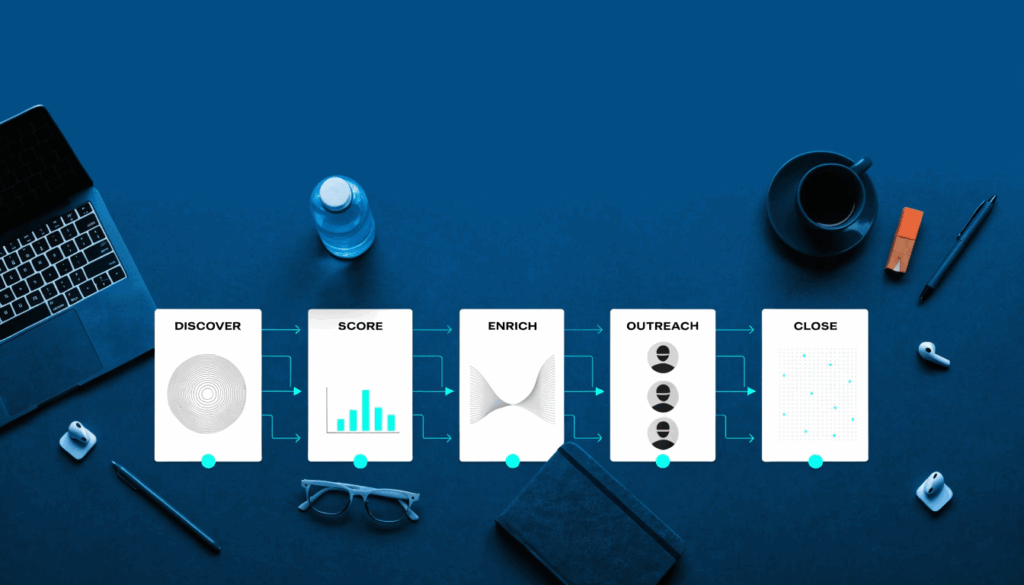
Specifically, it does four things that used to require human hours:
- Lead discovery — Scanning databases, LinkedIn, company websites, and news sources to surface prospects matching your ideal customer profile
- Lead scoring and qualification — Ranking leads by likelihood to convert, based on engagement signals, company growth indicators, and buying behaviour
- Data enrichment — Auto-filling CRM records with verified contact details, firmographics, and recent trigger events (new funding, hiring sprees, leadership changes)
- Personalised outreach drafting — Generating first-draft emails or call talk tracks based on each prospect’s specific context
The result: your team spends time talking to real prospects, not hunting for them.
The Singapore Numbers That Should Change How You Think About This
Singapore is not behind the curve on this. It’s ahead of it.
Salesforce’s February 2026 research specifically on Singapore found that 80% of sales organisations here already use AI for prospecting, forecasting, lead scoring, and email drafting. Half of Singapore sellers have already used AI agents. And 82% of sales leaders who have deployed agents say they are critical to meeting business demands.
The results at the rep level are striking too: 91% of AI users in Singapore said it deepens their understanding of customers, and 83% said it makes their job less stressful.
That second number is worth sitting with. Less stressful. In a role built on rejection and quota pressure.
Globally, Salesforce data shows that 83% of sales teams using AI reported revenue growth, compared to 66% without it. And reps who use AI daily are twice as likely to exceed their targets.
The competitive gap is opening up fast. Teams that adopt now aren’t getting a marginal advantage — they’re building a structural lead.
Where Traditional Prospecting Breaks Down
Let’s be specific about what’s slow.
A typical sales rep doing manual prospecting on a mid-market B2B target might spend:
- 15–30 minutes researching one account (company size, decision-makers, recent news, pain points)
- Another 10 minutes writing a semi-personalised cold email
- Time chasing outdated contact info or bounced emails
- Repeat — for every single prospect on the list
Scale that to even 20 prospects per day and you’ve consumed the morning. And that’s before you account for leads that were never qualified in the first place.
Research from Autobound puts a sharp number on the personalisation problem: signal-personalised outreach achieves 15–25% reply rates, compared to the 3–5% industry average for cold email. But the reason teams weren’t doing it before wasn’t laziness — it was time. Doing deep personalisation manually required 15–30 minutes per prospect. AI cuts that to seconds.
Here’s the math that changes how you plan headcount: a team sending 200 signal-targeted emails at 20% reply rate gets 40 conversations. A team sending 1,000 generic emails at 3% gets 30. The AI-powered team does more with less — and the conversations they land are warmer from the start.
5 Ways Singapore Sales Teams Are Using AI to Prospect Smarter
1. Ideal Customer Profile (ICP) Matching at Scale
Define your ideal customer — industry, company size, tech stack, headcount, revenue stage — and AI tools scan millions of records to surface accounts that match. What would take a researcher days now takes minutes.
For retail and hospitality teams in Singapore, this means you can build a targeted prospect list of, say, F&B chain operators with 50–200 staff that are actively hiring sales managers — a buying signal — in under an hour.
Tools like LinkedIn Sales Navigator, Apollo.io, and ZoomInfo offer this functionality, with Singapore-relevant data coverage.
2. Intent-Signal-Based Prioritisation
Not all leads are equal. AI monitors buying signals — content consumption, website visits, recent job postings, funding announcements — to tell you which accounts are actively researching solutions right now.
Gartner research found that sellers who use AI effectively are 3.7 times more likely to hit their sales quotas. The edge isn’t just speed — it’s knowing who to call first.
A hotel chain posting five new operations manager roles is a different conversation from one that’s been quiet for six months. AI flags that difference automatically.
3. CRM Enrichment and Hygiene
Dead data kills pipelines. Outdated emails, wrong job titles, missing phone numbers — every bad record costs time and damages your sender reputation over time.
AI-powered CRM tools (and yes, this includes AI-powered CRM platforms like Salesforce, HubSpot, and even newer tools like Clay or TheGro.ai) continuously verify and update contact data rather than letting it decay. When your rep picks up the list, it’s clean.
4. Personalised Outreach at Volume
Generic emails get ignored. We all know this. The problem was always that writing genuinely personalised emails at scale was a contradiction in terms.
AI resolves this. Tools can pull from a prospect’s recent LinkedIn activity, their company’s news, or specific trigger events to draft a first line that shows you’ve actually done your homework — before your rep has opened a single tab.
The rep still reviews and sends. But they’re editing, not writing from scratch. That’s a 70–80% time saving on outreach drafting.
5. AI-Assisted Lead Qualification During the Call
This is where it gets interesting. AI tools like Gong and Clari don’t just help before the call — they analyse what’s happening during it. Gong’s platform, trained on over 3 billion sales signals, shows reps in real time what top performers do differently, and flags deals at risk. One enterprise customer saved 6,700 hours on call prep, follow-up, and CRM updates using Gong alone.
The Hospitality and Retail Angle

Sales prospecting for Singapore’s hospitality and retail sectors has a specific shape.
Corporate group bookings, MICE contracts, F&B partnerships, supplier negotiations — these cycles are long, the buyers are busy, and the decision-makers rotate frequently. The research overhead is high.
AI prospecting tools are particularly effective here because:
- Trigger events are trackable: New hotel openings, expansion announcements, leadership hires — all feeding intent signals
- Personalisation matters more: A hospitality GM gets 50 cold emails a week. The one that references their recent renovation or event win gets opened
- CRM data decays faster: In an industry with high staff turnover, maintaining clean contact records manually is a losing battle
Teams that deploy workflow automation tools alongside CRM enrichment are the ones reducing prospecting time by the 32% that Salesforce projects for fully-implemented AI agents.
What Gets in the Way (And How to Handle It)
AI prospecting isn’t plug-and-play. A few honest caveats:
Data quality comes first. AI is only as good as the data feeding it. If your CRM is a mess, an AI layer on top of a mess gives you faster access to wrong information. Fix your data foundation before adding tools.
Reps need to know how to use it. Research from Sopro found that 81% of sales professionals say AI helps reduce time on manual tasks — but that only holds when reps actually know how to prompt, interpret, and act on AI outputs. Adoption without training is where the ROI disappears.
Human judgment still closes deals. The Salesforce Singapore data makes this point plainly: AI handles the top of the funnel, but negotiation, empathy, and trust-building remain human. The job isn’t going away. It’s shifting upstream.
The teams that struggle are the ones who buy a tool and expect transformation. The teams that win are the ones who rebuild their prospecting process around AI — and train their people accordingly.
How to Start: A Practical 4-Step Approach for Singapore SMEs
You don’t need a six-figure tech stack. Here’s a lean starting point:
Step 1: Audit your current prospecting time Track where your reps actually spend their hours for one week. Most teams are surprised. You can’t fix what you haven’t measured.
Step 2: Pick one high-friction area to automate first For most SMEs, this is either list building or outreach personalisation. Start there. Don’t try to automate everything at once.
Step 3: Clean your CRM before connecting any AI tool A one-week data hygiene sprint before onboarding any AI prospecting tool pays for itself in months. Garbage in, garbage out.
Step 4: Train your team on AI prompting and output review The competitive edge isn’t owning the tool. It’s knowing how to direct it and how to catch when it’s wrong. This is a skill — and it’s teachable.
The Course That Covers All of This in Two Days
Next week, we’re running a 2-day Mastering AI for Sales Growth and Team Dynamics — 16-17 April 2026 — specifically built for Singapore sales teams who want to put all of this into practice.
This session is personally taught by Charmain, founder of QD Academy and recognised on the Forbes 30 Under 30 Asia list. This is the only time she will be stepping in to teach this class herself.
The course covers:
- AI prospecting workflows: Finding and qualifying leads faster using AI tools
- Prompt engineering for sales: Getting usable outputs from AI, not generic noise
- CRM integration: Connecting AI tools to your existing workflow without breaking what works
- Closing with AI support: Using conversation intelligence to sharpen your approach in real deals
SkillsFuture credits apply, with subsidies of up to 90% for eligible Singaporeans and MCES for professionals aged 40 and above. Corporate customisation is available for teams of 12 or more.
Seats are limited. Register now by messaging us on WhatsApp here.
FAQ
What is AI for sales prospecting?
AI for sales prospecting means using artificial intelligence tools to automate the process of finding, qualifying, and prioritising potential customers. Instead of manually researching leads one by one, AI systems scan large datasets to surface high-potential accounts, score them by likelihood to convert, enrich your CRM with verified data, and help personalise outreach at scale.
How much time can AI actually save on prospecting?
Based on Salesforce’s 2026 research on Singapore sales teams, AI agents are projected to cut prospect research time by 32% and email drafting time by 34% when fully implemented. For teams doing heavy outreach, that can translate to recovering one or more productive selling days per week per rep.
Is AI prospecting suitable for smaller sales teams in Singapore?
Yes — and often more impactful for smaller teams. A two-person sales team that can prospect like a ten-person team has a structural advantage. Many tools (Apollo.io, LinkedIn Sales Navigator, and lighter CRM enrichment tools) have pricing tiers accessible to SMEs without enterprise budgets.
Will AI replace my salespeople?
No. The data consistently shows AI handles the top-of-funnel research and prioritisation work well, but the human side of selling — building trust, navigating objections, reading a room, negotiating — remains irreplaceable. What changes is how reps spend their time: less on admin, more on actual selling.
Do I need technical skills to use AI sales prospecting tools?
Not for most tools. The main skill is knowing how to set up your ideal customer profile correctly, interpret AI-generated lead scores, and prompt AI tools for personalised outreach. These are learnable in hours, not months. Our AI for Sales course covers exactly this.
Can I use SkillsFuture credits for AI sales training in Singapore?
Yes. SkillsFuture-approved AI courses, including our AI for Sales intensive, are claimable with your SkillsFuture credit. Eligible Singaporeans can access subsidies of up to 90%. Professionals aged 40 and above may qualify for the Mid-Career Enhanced Subsidy (MCES). Contact us at +65 8847 8417 to confirm your eligibility.