
Last updated: 29 October 2026
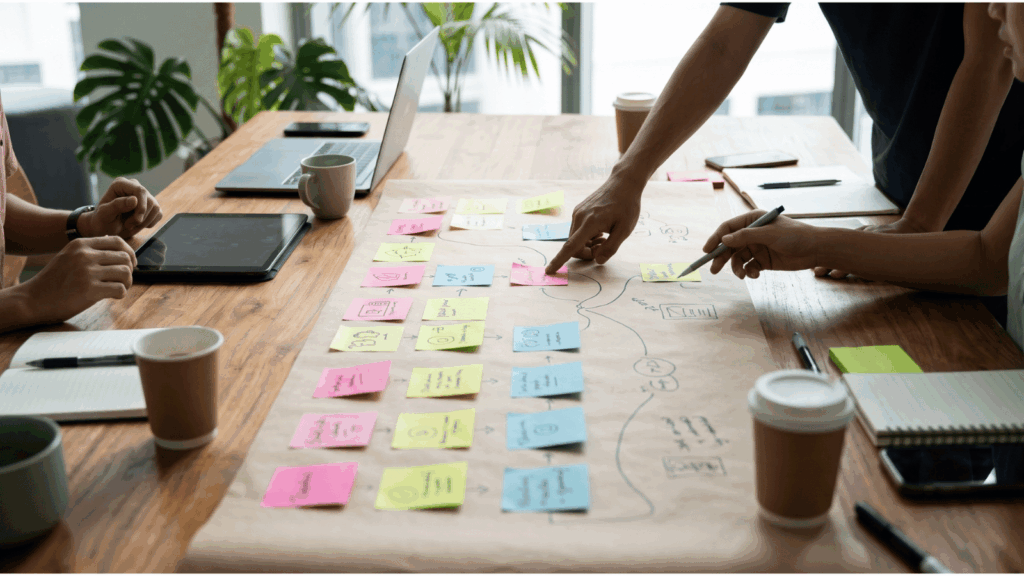
A customer journey map is a visual diagram of the steps a customer takes with your business, from first hearing about you to buying and coming back. It shows what the customer does, thinks and feels at each step, so your team can see where people get stuck and what to fix first.
What is a customer journey map?
Nielsen Norman Group defines a journey map as a visualization of the process that a person goes through in order to accomplish a goal (source). In a business setting, that goal is usually to buy something, get a problem solved or renew a service.
A good map is built from evidence: customer interviews, survey answers, CRM records, support tickets and website analytics. A map drawn from opinions in a meeting room shows what the team believes happens, which is often different from what customers experience.
The output is usually one page, with the stages across the top and rows underneath for customer actions, touchpoints, feelings and pain points. The row that matters most is the last one, where the team writes down what to change and who will change it.
What are the stages of a customer journey?
Most maps use five stages. The names vary between teams, but the logic is the same: the customer finds you, weighs you up, buys, uses what they bought, and may recommend you to others.
| Stage | What the customer is asking | Typical touchpoints | What to measure |
|---|---|---|---|
| Awareness | Who can help me with this problem? | Google search, social posts, referrals, events | Website visits, new enquiries, branded searches |
| Consideration | Is this the right option for me? | Website pages, reviews, WhatsApp chats, quotations | Reply time, enquiry-to-quotation rate |
| Decision | Can I trust this business, and is the price fair? | Proposal, demo, checkout, payment | Close rate, checkout drop-off, reasons for lost deals |
| Retention | Am I getting what I paid for? | Onboarding, service delivery, support, invoices | Repeat purchases, complaints, satisfaction scores |
| Advocacy | Would I tell others about this? | Review requests, referral offers, community groups | Review count, referrals, net promoter score |
Some teams add an Evaluation or Onboarding stage. Add one only if customers pass through it as a clear step with its own pain points. For a service business with a long sales cycle, splitting Consideration into Research and Shortlist is often worth doing.
What goes into a customer journey map?
The structure below follows the components Nielsen Norman Group describes, with pain points and owners added because they turn the map into a to-do list.
- Persona. One specific customer type, such as an operations manager at a 50-person logistics firm, instead of all customers.
- Scenario and goal. What the persona is trying to achieve, for example getting a quotation by Friday.
- Stages. The five above, or your own.
- Touchpoints. Every place the customer meets your business: website, WhatsApp, email, phone, store, invoice.
- Actions, thoughts and emotions. What the customer does and thinks at each step, plus a simple high or low feeling score.
- Pain points. Where the customer waits, repeats themselves or gives up.
- Opportunities and owners. The fix for each pain point and the person responsible for it.
Customer journey map vs user journey map vs consumer journey map
People search for all three terms and use them loosely. This is how they are usually used.
| Term | Usually means | Best suited to |
|---|---|---|
| Customer journey map | The full relationship between a customer and a business, across channels and over time | Marketing, sales and service teams in any business |
| User journey map | A person’s path through a product or interface, such as an app or a website | Product and UX design teams |
| Consumer journey map | The path to purchase for a consumer product, often across retail and online channels | Retail, FMCG and e-commerce brands |
Pick one term inside your company and keep using it. The mapping method is the same for all three, and only the scope changes.
Customer journey map example: a Singapore online retailer
This is an illustrative example, not a client case. A Singapore skincare retailer sells through its website and one store. Its persona is Mei, a 32-year-old who shops on her phone during her commute.
| Stage | What Mei does | Pain point | Fix |
|---|---|---|---|
| Awareness | Sees a friend’s Instagram post and taps through | The landing page loads slowly on mobile data | Compress images and test the page on a mobile connection |
| Consideration | Messages the store on WhatsApp to ask about ingredients | The reply arrives the next morning | Set up an auto-reply with common answers and a handover to a person during business hours |
| Decision | Adds a product to her cart | The shipping fee only appears at the last step | Show the shipping cost on the product page |
| Retention | Receives her order | No update after payment | Send automatic shipping and delivery messages |
| Advocacy | Likes the product | Nobody asks her for a review | Send a review request 14 days after delivery |
For more layouts, including a template you can copy, see customer journey map examples and templates.
How do you create a customer journey map?
- Choose one persona and one goal. Start narrow. A map that tries to cover every customer ends up describing none of them.
- Gather evidence. Talk to a handful of customers and pull data from your CRM, WhatsApp, email and support inbox.
- List the stages and touchpoints. Write down every place the customer meets your business, including offline ones.
- Mark actions, feelings and pain points. Use the customer’s own words from interviews and messages where you can.
- Write the fix and the owner. Every pain point needs a named person and a date.
- Review it every quarter. Customer behaviour and your own channels change, so the map needs updating.
AI tools can speed up the evidence work by summarising interview notes and support tickets and spotting patterns across them. Our guide to building an AI-powered customer journey map walks through that process step by step.
Why is customer journey mapping useful?
A journey map gives sales, marketing and service teams one shared picture of the customer. It makes handovers visible, such as the gap between a lead filling in a form and a salesperson calling back. It also gives you a priority list: fix the pain point closest to the sale first.
A map also feeds your wider plan. Once you know where the experience breaks down today, you can decide what it should become. Our guide to customer experience strategy shows how.
Frequently asked questions
What is a customer journey map in simple terms?
It is a diagram of every step a customer takes with your business, from first contact to repeat purchase, with notes on what they do, think and feel at each step.
How many stages are in a customer journey?
Most teams use five: awareness, consideration, decision, retention and advocacy. Some use four or six. The number matters less than whether each stage matches a real step your customers take.
What is the difference between a customer journey map and a user journey map?
A customer journey map covers the whole relationship with a business, including offline touchpoints such as phone calls and store visits. A user journey map follows a person through a product or interface and usually stays inside it.
Do I need software to make a customer journey map?
No. A whiteboard, a spreadsheet or a slide is enough. Dedicated software helps once you maintain several maps and want to share them. The harder part is gathering the evidence behind the map.
How often should I update a customer journey map?
Review it every quarter, and again after any big change to your pricing, channels or service process.
Learn to map and automate customer journeys with AI
QD Academy’s 3-day course, Developing an Effective Customer Journey Map using AI and Automation, teaches marketers, sales and service teams to build persona-based journey maps and set up AI follow-up workflows. The next cohort runs on 18 to 20 November 2026. Eligible Singapore learners can use SkillsFuture funding, and our team handles the grant paperwork. See grants and subsidies for eligibility, and check the course page for your fee.