
Cold calling is dead. But so is the version of inbound marketing most Singapore SMEs are running.
You’ve got a website. You’re posting on LinkedIn. Maybe you’re running some Google ads. But the leads still feel inconsistent — some months strong, others dry. And you’re not sure why.
The problem usually isn’t effort. Most SME owners and marketing teams are working hard — posting content, running promotions, responding to enquiries. The problem is inbound. Or rather, the gaps in it.
Here’s the problem: most SMEs understand what inbound marketing is. They just don’t know where they’re quietly bleeding. The five mistakes below show up in almost every SME we work with at QD Academy — and they’re the exact patterns we unpacked in our three-day Inbound Marketing with AI course this week.
If you missed it, you won’t miss the insights.
Let’s get into it.
What Inbound Marketing Actually Means for Singapore SMEs
Before we go into the mistakes, a quick grounding. Inbound marketing is the practice of attracting customers through content and value — rather than interrupting them with ads they didn’t ask for. HubSpot’s research consistently shows that content marketing generates three times more leads than outbound, at 62% lower cost. For resource-strapped SMEs, that math matters.
But here’s the catch: inbound only works when it’s structured. A blog that nobody reads isn’t inbound marketing. It’s just content. There’s a meaningful difference — and most SMEs are stuck somewhere in between.
Mistake #1: Creating Content Without Knowing the Search Intent Behind It

This is the most common one, and it quietly kills more inbound strategies than anything else.
Most SMEs produce content based on what they think their customers want to know. What they should be doing is researching what their customers are already searching for — and then building content that matches that exact intent.
Search intent falls into a few buckets: informational (someone learning), commercial (someone comparing options), and transactional (someone ready to buy). Each type needs a different content approach. A blog post that tries to close a sale when the reader is still in learning mode will bounce every time.
How AI fixes it: Tools like Google’s “People Also Ask” combined with AI assistants like ChatGPT or Perplexity let you map out what your audience is genuinely asking at each stage of their journey — in under 30 minutes. You can identify topic clusters, understand which keywords carry commercial vs informational intent, and build a content calendar that meets buyers where they actually are.
One hospitality SME we worked with discovered that their target customers were searching terms like “how to improve F&B team service” — not their product name at all. Shifting their content to address that search intent increased their organic traffic meaningfully within 90 days.
Mistake #2: Publishing Inconsistently and Wondering Why Nothing Ranks
Inbound marketing is not a campaign. It’s a system.
When SMEs treat content like a campaign — intense bursts followed by months of silence — they get campaign results: a spike, then a drop. Search engines reward consistency because consistency signals credibility. So does your audience. Research on Singapore SME digital marketing shows that sporadic marketing activity consistently underperforms against structured, maintained approaches — even when the total output is similar.
The real issue isn’t laziness. It’s bandwidth. Most SME marketing teams are one or two people wearing five hats. Publishing two high-quality blog posts a week sounds great until Tuesday hits.
How AI fixes it: AI content tools won’t replace your brand voice, but they can dramatically compress the time it takes to go from idea to draft. What used to take a skilled writer four hours now takes 60 to 90 minutes with AI assistance — research, draft, edit, and optimise. That’s the difference between publishing twice a month and twice a week.
At QD Academy, we teach a practical workflow where AI handles the research scaffolding and first draft, while the human brings the insight, authenticity, and judgment. That’s what makes content rank and resonate.
Mistake #3: Generating Traffic Without a Lead Capture System
This is painful to see, and it’s more common than you’d think.
An SME invests months in SEO, builds steady website traffic, then has no clear mechanism to capture that traffic as leads. No strong opt-in offer. No email sequence. No chatbot. Visitors arrive, look around, and leave — and the SME has no way to follow up.
According to DesignRush’s 2026 lead generation benchmarks, 80% of leads never convert on the first touch. The buyers who find you through content need multiple interactions before they’re ready to commit — warm inbound leads typically need five to twelve touchpoints. If you have no system to maintain that relationship, you’re handing leads to competitors who do.
How AI fixes it: AI-powered chatbots — tools like ManyChat, Intercom, or even a well-configured WhatsApp Business API integration — can capture visitor intent in real time, qualify leads, and route them into appropriate follow-up sequences. Email automation platforms with AI personalisation (HubSpot’s free tier, Zoho CRM, Mailchimp) can then nurture those leads over time with content tailored to where they are in the journey.
The goal isn’t to automate every touchpoint. It’s to ensure no lead falls through a gap simply because your team was busy.
Mistake #4: Treating Every Lead the Same
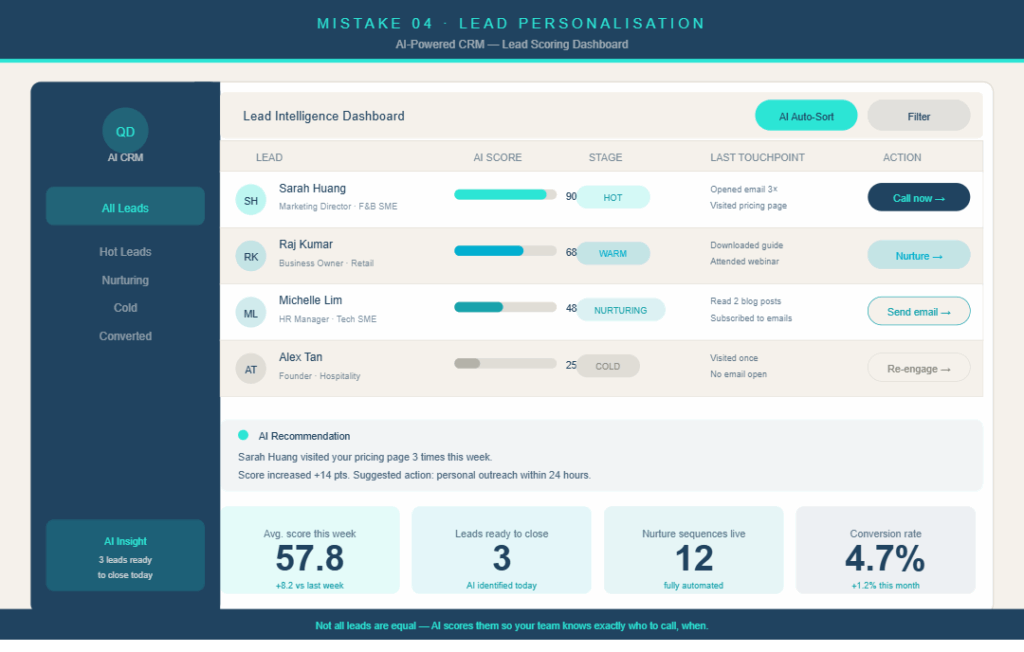
Not all leads are equal. A first-time website visitor who downloaded a free guide needs something very different from someone who just attended your webinar and asked three sharp questions about pricing.
Most SMEs send the same mass email to everyone on their list and wonder why open rates tank. The issue isn’t the email — it’s the absence of segmentation and personalisation. Research from Sopro found that two-thirds of SMEs that have adopted AI report efficiency improvements comparable to large enterprises — precisely because AI enables the kind of personalisation that used to require big teams.
Singapore’s market also adds a layer of complexity. A multilingual, multicultural audience means messaging that resonates in English may not land the same way with a Mandarin-speaking business owner or a hospitality professional who responds to tone differently. This is an area where nuance matters.
How AI fixes it: AI-powered CRM tools now make lead scoring accessible to SMEs without a dedicated data analyst. Tools like HubSpot, Zoho, and Pipedrive use behavioural signals — which emails someone opened, which pages they visited, which lead magnet they downloaded — to automatically score and segment leads. You then tailor your follow-up sequence based on where each lead actually is, not where you hope they are.
The result: a shorter sales cycle, a higher conversion rate, and a team that spends time on leads worth pursuing.
Mistake #5: Measuring Vanity Metrics Instead of Pipeline Metrics
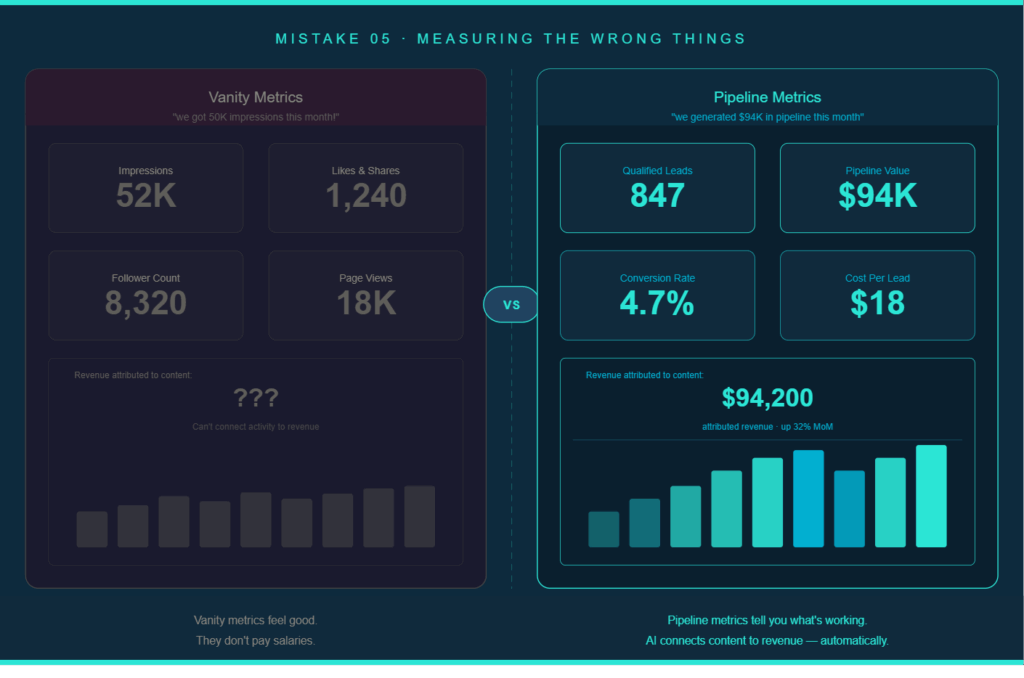
“We got 5,000 impressions this month.” Congratulations — but did that pay any salaries?
Impressions, likes, shares, and follower counts feel good. They don’t pay rent. As Globivio’s research on SME marketing ROI notes, many SME owners focus on metrics that signal activity rather than revenue — and as a result, they can’t tell whether their marketing is actually working.
The right metrics for inbound marketing are pipeline-oriented: how many qualified leads did this content generate? What’s the cost per lead from this channel? What’s the lead-to-customer conversion rate? How much revenue can we attribute to content-driven inbound?
Without these, you’re flying without instruments.
How AI fixes it: Analytics platforms with AI layers — GA4, HubSpot Analytics, or tools like Databox — can now surface these pipeline connections automatically, including multi-touch attribution that shows which content pieces contributed to a conversion, not just which one got the last click. This is what separates SMEs that scale their marketing confidently from those that keep guessing.
What This Actually Looks Like: Putting the Pieces Together
Here’s a simple framework for an inbound system that works, built on the fixes above:
Step 1 — Map your funnel. Identify your top 3 buyer personas and what they’re searching at each stage of their journey. AI can help you build this in one working session.
Step 2 — Build your content around search. Use keyword research to identify the highest-opportunity topics, then create content that genuinely answers those questions. Aim for 2-4 pieces per month consistently — not a burst of 20 articles followed by silence.
Step 3 — Set up instant lead response. Configure an automated response tool on your website and social channels. Even a simple chatbot that acknowledges the enquiry and sets response time expectations is better than silence.
Step 4 — Track the right numbers. Set up Google Analytics 4 with goal tracking, connect it to a CRM, and review conversion metrics monthly — not just traffic numbers.
Step 5 — Segment your messaging. Identify your 2-3 key audience segments and create a specific content angle for each. Your core value proposition stays the same; the framing and examples change.
None of this requires a large budget. It requires a clear process and the right tools. And in 2026, most of those tools are either free or subsidised through schemes like SkillsFuture enterprise credit.
The Bigger Picture: Why Inbound Matters More Than Ever in 2026
The Singapore job market is changing, the way people discover businesses is changing, and the expectations buyers have when they reach out are changing too.
AI search tools — ChatGPT, Gemini, Google’s AI Overviews — are now part of how buyers research solutions before ever visiting a website. The businesses that show up in those results are the ones with deep, well-structured inbound content. The ones who treated SEO as an afterthought, or published content with no distribution strategy, are becoming invisible.
Two-thirds of SMEs — 66% — report efficiency improvements from AI, nearly identical to the 65% reported by enterprises. AI is levelling the playing field. But only for SMEs who actually pick up the tools.
The five mistakes above aren’t strategic failures. They’re common patterns that happen when lean teams are juggling too much. The good news: they’re all fixable, and the fixes are now faster and more accessible than at any point in the last decade.
The Underlying Pattern
Look at these five mistakes together and you notice something: none of them are about effort. Every SME on this list is working hard. The gap is structure.
Inbound marketing works when content matches intent, when publishing is consistent, when leads are captured and nurtured intelligently, when follow-up is personalised, and when success is measured in revenue — not reach.
AI doesn’t replace the human judgment and authentic communication that builds real trust with your audience. IMDA data shows that over 7,200 Singapore SMEs have already adopted AI-enabled solutions — and the ones who succeed pair the tools with clear strategy. AI handles the volume and consistency. You bring the clarity, empathy, and conviction that actually closes.
Ready to Build an Inbound System That Actually Works?
Our Inbound Marketing with AI course is designed for exactly this — Singapore SMEs and marketing professionals who want a practical, hands-on system for attracting and converting leads, without burning through ad budgets.
In three days, you’ll build a full inbound framework specific to your business: from content strategy and keyword targeting to AI-powered lead capture and conversion tracking.
Explore the course HERE
Backed by SkillsFuture and eligible for up to 90% subsidy for qualifying Singaporeans and PRs.

FAQ
What is inbound marketing and why does it matter for Singapore SMEs?
Inbound marketing is a strategy that attracts customers to your business by creating content and experiences that are genuinely useful to them — rather than interrupting them with ads. For Singapore SMEs, it matters because it compounds over time (content you publish today can generate leads three years from now), it costs less than outbound at scale, and it tends to attract higher-quality leads who have already shown intent.
How is AI changing inbound marketing for small businesses?
AI is reducing the time and expertise required to execute inbound marketing well. Tasks that used to require specialists — keyword research, content planning, lead scoring, personalised messaging — can now be done faster and cheaper with AI tools. Critically, AI is also enabling small teams to respond to inbound leads instantly, which is one of the biggest conversion levers available.
Can AI replace a marketing team for inbound marketing?
No — and it shouldn’t. AI handles the repeatable, data-intensive parts of inbound marketing well: keyword research, content outlines, automated first responses, analytics interpretation. The human elements — strategic decisions, genuine relationships, brand voice, nuanced client understanding — still require people. The best approach is a hybrid: AI handles the operational load, humans focus on judgment and connection.
How long does it take to see results from inbound marketing?
Most inbound marketing takes 6-12 months to generate consistent, predictable results. This is its main downside compared to paid advertising, which can generate leads immediately. However, inbound builds compounding value — a piece of content you publish in month 2 can still be generating leads in year 3. SMEs who invest early tend to build a significant sustainable advantage over those who don’t start.
What SkillsFuture funding is available for inbound marketing training?
Singapore citizens and PRs may be eligible for SkillsFuture Credit to offset training costs for approved inbound marketing and digital marketing courses. Those aged 40 and above may qualify for the Mid-Career Enhanced Subsidy, which can cover up to 90% of course fees. Businesses can also explore SkillsFuture Enterprise Credit for team training.