
You’re ten or fifteen years into your career. Things are going fine — but you can feel the ground shifting. AI tools are showing up in every job posting. Younger colleagues are talking about prompts and automation. And somewhere in the back of your mind, a question is forming: Am I keeping up?
If that sounds familiar, you’re not alone. Across Singapore’s job market, mid-career professionals are grappling with exactly this moment — and the good news is that the infrastructure to help you navigate it has never been more accessible.
This guide covers everything you need to know about AI upskilling for mid-career professionals in Singapore in 2026: what’s available, how to fund it, which programmes are worth your time, and how to actually make the transition stick.

Why AI Upskilling Matters for Mid-Career Professionals in Singapore
Singapore’s job market is not in crisis — but it is in transformation. The industries absorbing the most growth (fintech, healthtech, professional services, logistics) are all integrating AI faster than most companies can train their existing workforce.
For mid-career professionals, this creates two competing realities. On one hand, your experience is genuinely valuable — domain knowledge, client relationships, and professional judgment can’t be automated away. On the other hand, if you can’t operate AI tools fluently, you risk being outcompeted by someone who has your experience and that skill layer on top.
The combination of both is what employers in Singapore are actively looking for right now. Here’s why upskilling makes sense:
- Industry transformation: AI is reshaping finance, healthcare, marketing, operations, and education — it’s no longer a ‘tech sector’ issue.
- Salary uplift: Professionals with verified AI skills command higher salaries and are considered for roles with broader strategic remit.
- Job security: AI proficiency reduces your exposure to automation and opens pathways to roles that are harder to displace.
- Government backing: Singapore’s national AI strategy is underpinned by real funding — SkillsFuture credits, SSG-funded courses, and mid-career subsidies.
- Global competitiveness: Singapore aims to be a regional AI hub. A skilled mid-career workforce is central to that goal.
The opportunity is real. The funding exists. The question is where to start.
The Current Landscape of AI Education in Singapore
Singapore is becoming a hub for AI education. The city-state boasts world-class institutions offering diverse AI courses that cater to various skill levels, from beginners to advanced learners.
The range of AI courses in Singapore is impressive. Universities and private institutions offer comprehensive curricula and cover essential AI fields such as machine learning and data analysis. This breadth ensures every learner finds a suitable program.
Here’s a snapshot of AI education in Singapore:
- Universities: Prestigious institutions like NUS and NTU provide cutting-edge AI courses.
- Private Institutes: Numerous private entities offer flexible learning options.
- Online Platforms: Convenient online courses suit working professionals.
- Industry Partnerships: Collaborative programs with tech companies enhance real-world learning.
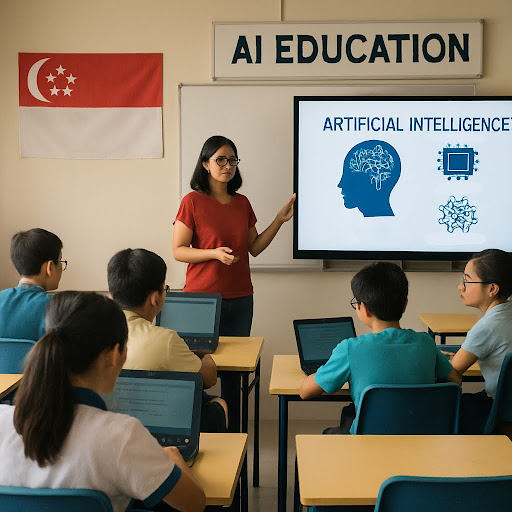
Support from the government bolsters AI education through initiatives and funding that encourage broader participation in AI learning. This national focus on AI underscores its importance to Singapore’s future.
Hands-on experience is a cornerstone of AI education as real-world projects and internships provide practical skills. This experiential learning bridges the gap between theory and practice. Consequently, graduates are well-prepared to integrate AI into their work environments.
Key Benefits of AI Upskilling for Mid-Career Professionals
AI skills offer numerous advantages for mid-career professionals. Upskilling in AI can significantly enhance job prospects. It empowers individuals to transition to new, tech-driven roles.
One of the greatest benefits is improved problem-solving abilities. AI training hones analytical thinking, crucial for many professions. Enhanced decision-making skills can lead to better outcomes in challenging scenarios.
AI expertise can also lead to higher salaries and job security. Companies value employees who understand AI, making them indispensable. Additionally, AI skills are universally applicable across industries, further increasing job stability.
Here are some key benefits:
- Enhanced Creativity: AI can foster innovative solutions.
- Career Advancement: Opens doors to leadership roles.
- Cross-Disciplinary Opportunities: AI skills are valuable in various fields.
- Improved Efficiency: Automation of routine tasks with AI tools.
Networking opportunities also arise from AI upskilling. Engaging with peers and experts in the AI community can provide valuable insights. This professional interaction enriches career journeys, paving the way for future success.
Types of AI Courses and Training Available in Singapore
The range of AI training in Singapore spans from beginner-friendly introductions to advanced technical programmes. Here’s how to think about the landscape:
Foundational / Introduction to AI
These courses cover what AI is, how it works conceptually, and how to use AI tools in a professional context without requiring any technical background. Ideal for mid-career professionals who want practical application over programming theory.
Applied AI for Business and Productivity
This is the fastest-growing category — and the most relevant for mid-career professionals. Courses here focus on using AI tools to improve workflow automation, sales performance, marketing strategy, and team productivity. You don’t need to know how to build an AI model; you need to know how to work with one.
QD Academy’s SkillsFuture-claimable courses sit squarely in this category — built for working professionals who need skills they can apply on Monday morning, not theory for a semester-end exam:
- AI-Powered Productivity – Strategies for the Modern Workplace — Learn how to use AI tools to reclaim hours from routine tasks, streamline team workflows, and work smarter across common professional scenarios.
- Mastering AI for Sales Growth and Team Dynamics — Purpose-built for sales professionals and team leads who want to use AI to close more deals, coach their teams, and drive revenue with data.
- Developing Effective Inbound Marketing Strategies with AI — Covers how AI is changing B2B and B2C marketing in Singapore — from content strategy to lead nurturing — with practical frameworks you can deploy immediately.
- Developing an Effective Customer Journey Map using AI and Automation — Learn to map your customers’ experience, identify friction points, and use AI-powered automation to create smoother, higher-converting journeys.
All four are eligible for SkillsFuture funding and designed specifically for the mid-career professional who wants applied AI skills, not abstract theory.
Data Science and Machine Learning
More technical routes suited to professionals in analytics, engineering, or product roles who want to understand AI more deeply — or pivot into a data-focused role. Programmes range from short certification courses to full master’s degrees.
AI for Leadership and Strategy
A growing category aimed at managers and business owners who need to make strategic decisions about AI adoption in their organisations — less about using tools, more about leading teams through digital transformation.

Overall, Singapore’s AI training options are comprehensive. They support diverse learning preferences and help professionals enhance their skills. This positions Singapore as a leading hub for AI education.
How to Choose the Right AI Course for Your Career Goals
Selecting the right AI course is crucial for career advancement. First, assess your current skills and identify gaps. Understanding where you stand will guide your decision-making process.
Consider your career objectives and industry needs. Are you aiming to specialize in data science or develop machine learning expertise? Align your course choice with these aspirations for maximum benefit.
Research various programs and their content thoroughly. Look for courses that offer both technical and soft skills training. Practical experience is also essential for a holistic learning experience.
When evaluating options, keep these points in mind:
- Course content relevance: Does it match your career goals?
- Learning format: Is it flexible to accommodate your schedule?
- Accreditation and recognition: Is it industry-recognized?
Seek feedback from past participants. Reviews and testimonials can provide valuable insights. Additionally, consider mentorship or career support offerings, which can enhance your learning journey.
Choosing the right course requires careful consideration. By aligning options with your career goals, you’ll ensure your investment in learning leads to significant personal and professional growth.
Government Initiatives and Funding for AI Training in Singapore
Through strategic initiatives, the Singapore government aims to position Singapore as a global leader in AI technology. This commitment ensures mid-career professionals have access to quality upskilling opportunities.
Subsidies and grants are available for professionals seeking to enhance their skills, making AI courses more accessible. These financial aids help to reduce the burden of course fees, encouraging more individuals to participate in AI education.
Several key programs illustrate this support. SkillsFuture, for instance, offers credits that individuals can use for AI training. Workforce Singapore also provides grants for various AI skill development programs. Such initiatives highlight the government’s dedication to building a future-ready workforce.
Here are some notable government-supported programs:
SkillsFuture Credit
All Singaporeans aged 25 and above receive SkillsFuture credits to spend on approved courses. The SkillsFuture framework includes AI-specific learning pathways, and credits can be used for both university-linked programmes and approved private providers like QD Academy.
Mid-Career Enhanced Subsidy (MCES)
Singaporeans aged 40 and above qualify for the Mid-Career Enhanced Subsidy, which covers up to 90% of course fees for SSG-funded programmes. This is arguably the most underused funding mechanism in Singapore — most professionals who qualify for it don’t know it exists or don’t know how to apply.
Career Conversion Programme (CCP)
The Career Conversion Programme supports mid-career professionals making a genuine role switch. Employers receive salary support when they hire and train eligible candidates through an approved CCP provider. If you’re pivoting into a new function — say, from operations to digital marketing or from HR to data analytics — this is the programme to explore.
TechSkills Accelerator (TeSA)
TeSA focuses on technology job placements and training — particularly useful if you’re targeting a role in a tech company or moving into a tech-adjacent function within your existing organisation.
Jobseeker Support Scheme
For professionals who are currently between roles, the Jobseeker Support Scheme provides financial support during an active career transition. This is separate from the standard upskilling funding and worth understanding if you’re in a period of career change.
For a full breakdown of what you’re eligible for, QD Academy’s grants and subsidies page is a useful starting point — it maps funding options to specific course types.
These initiatives foster a culture of continuous learning. By leveraging available funding, mid-career professionals in Singapore can confidently pursue AI upskilling, ultimately contributing to their career advancement and the nation’s economic growth.
Success Stories: Mid-Career Professionals Who Transformed with AI Skills
The shift is not hypothetical. Mid-career professionals across Singapore are using AI upskilling to move into roles and responsibilities they wouldn’t have had access to otherwise.
Take the case of Sarah, a marketing manager. She found that integrating AI into her strategies amplified campaign reach and effectiveness. With AI skills, she transitioned into a new role, spearheading data-driven marketing initiatives in her company.
Another inspiring story is that of John, an engineer. With AI training, he was able to automate complex processes. This efficiency boost not only improved his work productivity but also opened doors to leadership roles.
A list of transformations:
- Sarah: Advanced from marketing manager to data-driven strategist.
- John: Leveraged AI for process automation, leading to promotion.
- Emily: Switched from HR to a tech industry role with AI insights.
These success stories underline the transformative potential of AI upskilling. By investing in AI education, these professionals not only adapted to industry changes but also thrived, setting a remarkable example for others.
Practical Tips for Integrating AI Skills into Your Career
Integrating AI skills into your career requires both strategy and action. Here is a checklist to guide your integration journey:
- Start with one tool in your current role. Don’t try to overhaul everything at once. Pick one repetitive task — meeting summaries, first-draft emails, data analysis — and commit to using an AI tool for it for 30 days.
- Document what changes. Keep a simple log of time saved, quality improvements, or new capabilities. This becomes evidence when you want to make the case for a promotion or role expansion.
- Stay current without drowning. The AI landscape moves fast, but most of what you need to know as a practitioner doesn’t change weekly. A monthly review of key developments is enough.
- Invest in your network. Join communities of professionals using AI in your industry. The Singapore AI and tech community is active — and peer learning accelerates skill development faster than any course alone.
- Connect learning to a specific goal. ‘Learn AI’ is too vague to stay motivated. ‘Use AI to cut my weekly reporting time in half by June’ is actionable.
By following these tips, you’ll effectively integrate AI into your career. This approach not only enhances your job performance but also positions you for future growth and opportunities.
Overcoming Challenges in AI Upskilling
Embarking on an AI upskilling journey can be daunting. Many mid-career professionals face time constraints due to work and personal commitments. Balancing these responsibilities with learning requires strong time management skills.
Limited technical background can also pose a challenge. Some professionals may feel intimidated by the technical jargon and complexity of AI topics. Overcoming this requires starting with basic courses to build a solid foundation before advancing to more complex subjects.
Financial constraints are another common concern. AI courses can be pricey, making it difficult for some to afford. However, many affordable or even free resources are available online.
Here are a few strategies to tackle these challenges:
- Prioritise time for learning.
- Start with beginner-friendly courses.
- Explore online free resources.
- Seek employer support for course fees.
By addressing these hurdles, professionals can ease their AI upskilling journey, paving the way for successful career transformation.
The Future of AI Careers in Singapore
The future of AI careers in Singapore is very promising. As AI continues to grow, industries across the board are increasingly seeking AI skills. This trend indicates a strong future demand for AI professionals.
Singapore is positioning itself as a global leader in AI technology. The government is actively investing in AI initiatives, helping to create numerous opportunities. This environment enables innovation and fosters a culture conducive to AI career growth.
For mid-career professionals, this is an opportune time to upskill. By acquiring AI expertise, they can secure roles that will likely command higher salaries. Furthermore, AI skills can lead to diverse career paths within the tech industry.
In the future, expect:
- Growing demand for AI roles.
- Increased investment in AI innovation.
- More interdisciplinary opportunities.

Ready to Take the Next Step?
AI upskilling isn’t about keeping up with trends. It’s about building a career that stays relevant in a job market that’s changing, whether you’re ready or not.
The good news: you don’t have to figure this out alone. Singapore has built one of the world’s most accessible upskilling ecosystems — and there are programmes designed specifically for mid-career professionals with exactly your experience level.
Whether you’re looking to sharpen your current role, explore a career switch, or lead your team through a digital transformation, QD Academy’s AI courses are designed to get you there — with SkillsFuture funding, practical frameworks, and instructors who’ve done this work in the real world.
Subsidies of up to 90% are available for eligible Singaporeans.
Explore our courses → HERE
FAQ
What is the best AI course for mid-career professionals in Singapore?
The best course depends on your goals. For applied productivity and workflow skills, short WSQ-funded workshops from providers like QD Academy are practical and immediately applicable. For a deeper career pivot, SSG-funded specialist diplomas or university-linked programmes offer more structured pathways. The key is matching the course to your specific career direction rather than choosing the most popular option.
How much does AI upskilling cost in Singapore?
Course fees vary widely, but eligible Singaporeans can offset significant costs through the grants and subsidies. Singaporeans aged 40+ on SSG-funded courses can receive up to 90% in subsidies, making many high-quality programmes accessible for well under $500 out of pocket.
Can I claim SkillsFuture for AI courses?
Yes — many AI courses from SSG-approved providers are SkillsFuture credit-eligible. Always verify eligibility on the MySkillsFuture portal or directly with the course provider before enrolling.
What is the Career Conversion Programme and how does it work?
The Career Conversion Programme (CCP) supports mid-career professionals making a genuine role switch. Employers receive salary support for hiring and training eligible candidates through an approved CCP provider. If you’re pivoting into a new function with AI skills, your new employer may be able to offset a significant portion of your first-year salary through this scheme.
Do I need a technical background to learn AI?
No. The majority of high-value AI applications for mid-career professionals — content generation, workflow automation, data analysis, customer journey mapping — require no coding or machine learning background. Applied AI courses are designed specifically for professionals who want to use tools effectively without becoming engineers.
How long does AI upskilling take?
It depends on the depth. A short workshop can deliver practical skills in 2–3 days. A specialist diploma typically runs 12–18 months part-time. Most working professionals start with a focused short course to build confidence and practical skills, then decide whether to pursue deeper qualification based on their career direction.