

Most Singapore SMEs are not short on effort when it comes to marketing. They post on social media, run ads, send emails, maybe even publish a blog or two. But despite all that activity, leads trickle in slowly, and the ones that do arrive are often unqualified.
The problem is rarely a lack of hustle. It is almost always a lack of system.
Inbound marketing, done right, is the system that turns your website, content, and email into a lead-generating engine that works even when your team is offline. But when SMEs get it wrong, they end up burning time and budget on tactics that never connect. And with generative AI for business becoming more accessible every month, there is no reason to keep making these mistakes in 2026.
Whether you are a marketing manager looking to fix what is broken, or a mid-career professional exploring a career change into digital marketing, these five inbound marketing mistakes are worth understanding. They show up in nearly every SME we talk to.
Mistake 1: Treating All Website Visitors the Same
A first-time visitor who lands on your homepage from a Google search is in a completely different headspace from a returning visitor who has already downloaded your pricing guide. Yet most SME websites serve the same content, the same pop-ups, and the same calls-to-action to everyone.
This is the equivalent of a salesperson giving the same pitch to someone walking into the store for the first time and someone who has been back three times. It does not work in person, and it does not work online.
How AI fixes this
AI-powered personalisation tools can segment visitors in real time based on behaviour, traffic source, and stage of the buying journey. For example, a visitor from LinkedIn who has viewed your services page twice could see a case study and a “Book a call” button. A new visitor from Google might see an introductory guide instead.
Tools like Engages.ai, which functions as an AI-powered CRM platform, let SMEs set up these smart workflows without needing a dedicated developer. The system learns which content converts best for each segment and adjusts automatically. This is applied AI in its most practical form: not flashy, just effective.
According to IMDA’s 2025 Singapore Digital Economy Report, SMEs that adopted AI-enabled solutions saw an average cost saving of 52%. Personalisation is one of the fastest ways to capture that kind of efficiency in marketing.
Mistake 2: Creating Content Without a Keyword Strategy
Here is a pattern we see often: an SME publishes blog posts about topics the founder finds interesting, or whatever the marketing intern came up with that week. There is no keyword research, no search intent mapping, and no content calendar.
The result? Content that nobody searches for, sitting on a website that Google barely crawls.
Content without strategy is just noise. And Singapore’s SME landscape is too competitive for noise. With over 95% of SMEs already adopting at least one digital area according to IMDA, the bar for standing out keeps rising.
How AI fixes this
AI-powered SEO tools like Semrush and Ahrefs can identify exactly what your target customers are searching for in Singapore, how competitive each keyword is, and what kind of content ranks best. More importantly, generative AI tools like ChatGPT can help you create content briefs and first drafts aligned to those keywords in a fraction of the time.
But here is the part most people miss: AI-generated content still needs a human editor who understands your audience. The best-performing inbound content in 2026 is AI-assisted but human-led. Use AI for research, structure, and speed. Keep the voice, stories, and industry expertise human. That is the real difference between AI learning as a concept and actually applying it to grow your business.
This is exactly the approach taught in QD Academy’s Developing Effective Inbound Marketing Strategies with AI course, where participants learn to build content systems that attract, not chase.
Mistake 3: Collecting Leads but Never Nurturing Them
This might be the most expensive mistake on this list.
An SME runs a campaign, collects 200 email addresses, and then… nothing. Maybe they send a one-off promotional email a month later. By then, most of those leads have gone cold. They have forgotten who you are. They have moved on.
Lead generation without lead nurturing is like filling a bucket with holes in it. You keep pouring, but nothing stays.
How AI fixes this
Marketing automation platforms, sometimes called workflow software or workflow automation tools, can trigger personalised email sequences the moment someone fills out a form, downloads a resource, or visits a pricing page. AI takes this further by optimising send times, subject lines, and even which content to serve based on each lead’s behaviour.
For example, if a lead opens your email about AI productivity tools but ignores the one about sales training, the system learns to send more productivity-related content. No manual tagging required.
With Engages.ai, which combines AI CRM with marketing automation, SMEs can set up automated nurture sequences that run 24/7, moving leads from “just browsing” to “ready to buy” without anyone manually following up. That is not futuristic. It is what well-run inbound marketing looks like today.
Mistake 4: Running Ads Without a Landing Page Strategy
We have seen SMEs spend thousands on Facebook and Google ads that drive traffic to their homepage. Not a tailored landing page. Not a specific offer page. The homepage.
Think about it: someone clicks an ad about “AI training Singapore,” and lands on a homepage that talks about five different services, a company timeline, and a team photo. Where is the connection? Where is the next step?
The disconnect between ad promise and landing experience is one of the biggest reasons SMEs see high cost-per-click but low conversions. Among AI companies in Singapore and digital-first businesses, this gap is closing fast. SMEs that do not adapt risk falling behind.
How AI fixes this
AI copywriting tools can generate landing page variations quickly, and A/B testing platforms can determine which versions convert best. But the real win is in AI-powered customer journey mapping.
When you understand how a customer moves from awareness (“I have a problem”) to consideration (“What are my options?”) to decision (“I am choosing this solution”), you can build landing pages that meet them at each stage. This kind of digital transformation might sound complex, but the tools available in Singapore today make it surprisingly accessible, even for small teams.
AI tools can analyse your existing traffic data, identify drop-off points, and suggest specific changes, from headline tweaks to form placement, that improve conversion rates. QD Academy’s course on Developing an Effective Customer Journey Map using AI and Automation covers exactly this process, step by step.
Mistake 5: Measuring Vanity Metrics Instead of Revenue Impact
Likes, followers, impressions. They look good on a monthly report, but they do not tell you whether marketing is actually driving sales.
We have talked to SME owners who proudly share that their Instagram engagement went up 40%, but when asked how many sales came from it, the answer is usually a long pause followed by, “We are not sure.”
If you cannot trace a lead from first touch to closed deal, you do not have an inbound marketing system. You have an activity tracker.
How AI fixes this
An AI-powered CRM platform with built-in analytics can connect the dots between marketing activity and actual revenue. It tracks which blog post brought in a lead, which email sequence moved them forward, and which touchpoint finally converted them. This is applied AI and analytics working together to show you what is real versus what is just noise.
This is called multi-touch attribution, and it used to be something only enterprises could afford. Today, platforms like Engages.ai give SMEs the same visibility. You can see exactly which campaigns generate revenue and which ones are just generating noise.
When you measure what matters, you stop wasting budget on what does not.
What These Mistakes Have in Common
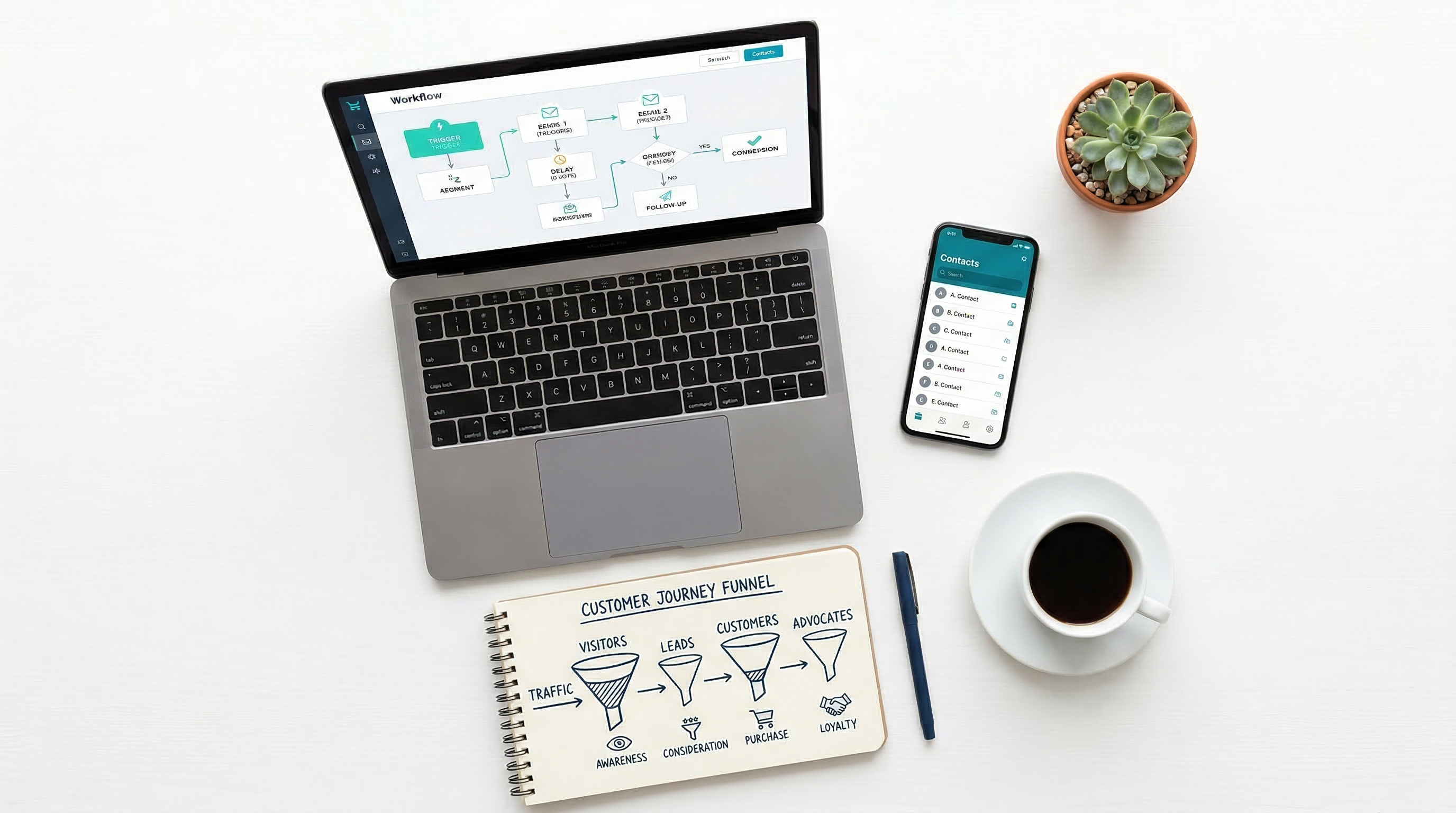
Every single mistake on this list comes down to the same root cause: running marketing as a series of disconnected activities instead of building an integrated system.
Inbound marketing is not just content. It is system design. The best marketers today are system thinkers. They map customer journeys, automate engagement across channels, and use AI to create consistent, scalable campaigns.
The good news? Singapore’s government is actively supporting this kind of digital transformation. Through SkillsFuture funding, the Skill Development Fund (SDF), and SSG funding, eligible professionals can access substantial subsidies for AI training and digital marketing courses. The SkillsFuture Enterprise Credit also helps businesses offset the cost of sending their teams for training. For mid-career professionals, the mid-career enhanced subsidy and Career Conversion Programmes (CCP Singapore) offer even more support, with subsidies reaching up to 90% for eligible Singaporeans.
The SME AI adoption rate in Singapore tripled from 4.2% in 2023 to 14.5% in 2024, and that number is only accelerating. The window to build these capabilities is open. But it will not stay open forever. SMEs that wait too long will find themselves competing against businesses that already have AI-powered inbound engines running around the clock.
If you are considering a career switch in Singapore towards digital marketing or AI-related roles, the demand for professionals who can set up and manage these systems is growing fast. The same mid-career switch programmes that fund AI training can also be a pathway into one of the most in-demand skill sets of 2026.
Build Your AI-Powered Inbound Marketing System
QD Academy’s Developing Effective Inbound Marketing Strategies with AI course is running 11-13 March 2026. If you missed this run, you can join the waitlist for the next one.
In this hands-on artificial intelligence course in Singapore, you will learn to map customer journeys, set up workflow automation using AI-driven tools, and build inbound campaigns that generate qualified leads on autopilot. Whether you are an experienced marketer or just starting your AI learning journey, the course is designed to be practical and immediately applicable. It is led by Koh Kang Liang, an ACTA-certified trainer who has guided dozens of Singapore SMEs through digital transformation.
The course is SkillsFuture-claimable and listed under SSG courses, so eligible participants can tap into SkillsFuture subsidies and the mid-career enhanced subsidy for up to 70-90% off. You can also use your SkillsFuture Enterprise Credit if your company is sponsoring your training.
Explore the course details and register: Developing Effective Inbound Marketing Strategies with AI
Browse all QD Academy courses: theqdacademy.com/courses
Frequently Asked Questions
What is inbound marketing, and why does it matter for Singapore SMEs?
Inbound marketing is a strategy where you attract customers by creating valuable content and experiences tailored to them, rather than pushing ads or cold calls. For Singapore SMEs with limited marketing budgets, it is one of the most cost-effective ways to generate qualified leads consistently. When combined with AI tools for workflow automation and personalisation, it becomes even more powerful.
How can AI improve my inbound marketing results?
AI helps at every stage: keyword research and content creation, lead scoring and segmentation, automated email nurturing, landing page optimisation, and attribution analytics. Think of it as applied AI for your sales and marketing funnel. It reduces manual work and improves accuracy, so your team can focus on strategy and relationship-building.
Do I need technical skills to use AI marketing tools? Is this suitable for AI beginners?
Not necessarily. Most modern AI marketing platforms are designed for non-technical users, making them a great fit even as an AI beginner course in applied skills. Tools like Engages.ai offer drag-and-drop workflow builders, pre-built templates, and guided setup. That said, knowing how to think strategically about customer journeys and data will help you get more out of any tool. QD Academy’s courses are structured to take you from beginner to confident practitioner.
What SkillsFuture subsidies are available for inbound marketing and AI training courses?
Eligible Singapore citizens and PRs can use SkillsFuture Credits to offset course fees. The SkillsFuture Enterprise Credit helps businesses fund team training. SME-sponsored employees may qualify for the mid-career enhanced subsidy of up to 70-90% through the Enhanced Training Support for SMEs (ETSS). UTAP funding is also available for NTUC union members. If you are exploring a career conversion or mid-career conversion programme, many of these programmes are eligible for additional SSG funding. Check the SkillsFuture portal for the latest eligibility criteria.
Can I get an AI certification in Singapore through these courses?
QD Academy issues a Certificate of Completion for each course, which can support your professional development and signal your commitment to AI learning and digital transformation. If you are building toward an AI certification in Singapore, completing practical courses like Inbound Marketing with AI and Customer Journey Mapping with AI gives you hands-on portfolio evidence that employers value, often more than theory-only certifications.
Is inbound marketing suitable for B2B businesses in Singapore?
Absolutely. Inbound marketing is especially effective for B2B because the sales cycle is longer and buyers do more research before making a decision. Content like case studies, industry guides, and webinars can position your business as a trusted authority. When paired with an AI-powered CRM platform like Engages.ai, you can nurture those longer sales cycles with automated, personalised touchpoints that keep you top of mind.