
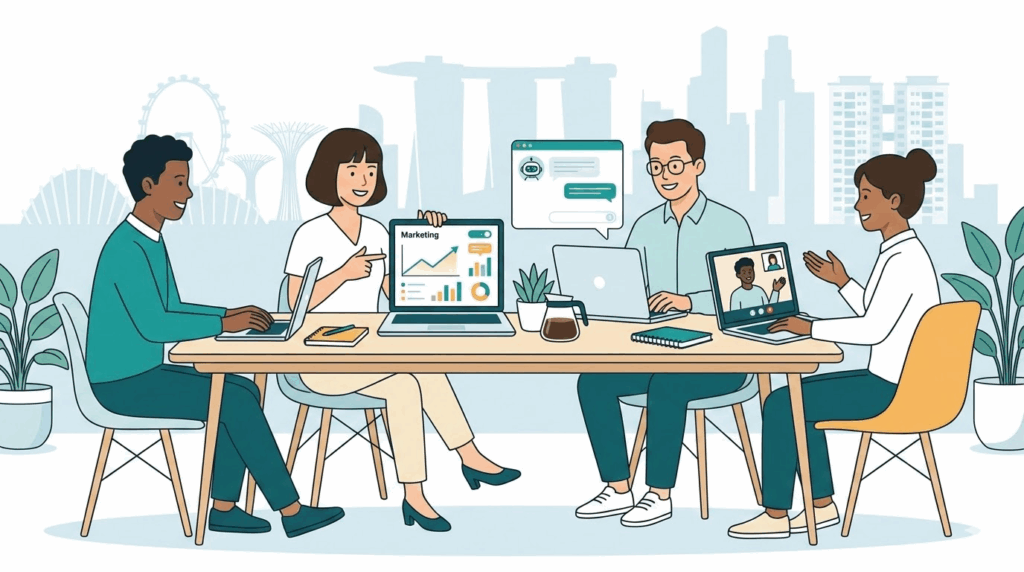
Cold calling is dying. If you run an SME in Singapore and your sales team still spends mornings working through call lists, you already know the hit rate is brutal. Most people don’t pick up. The ones who do? They don’t want to talk.
But here’s what’s actually working: businesses that create useful content, show up when prospects are already searching, and use AI to automate the follow-up. That’s inbound marketing. And AI has made it accessible to small teams that couldn’t afford to run these systems even two years ago.
This isn’t theory. Singapore SMEs across hospitality, professional services, and retail are already using AI-powered inbound strategies to generate qualified leads without adding headcount. The tools exist, many of them free or subsidised. The question is whether your team knows how to use them.
Let’s break down what’s actually changed, what tools work, and how to get started — even if your marketing team is just you and one other person.
What Is Inbound Marketing (and Why Should Singapore SMEs Care)?
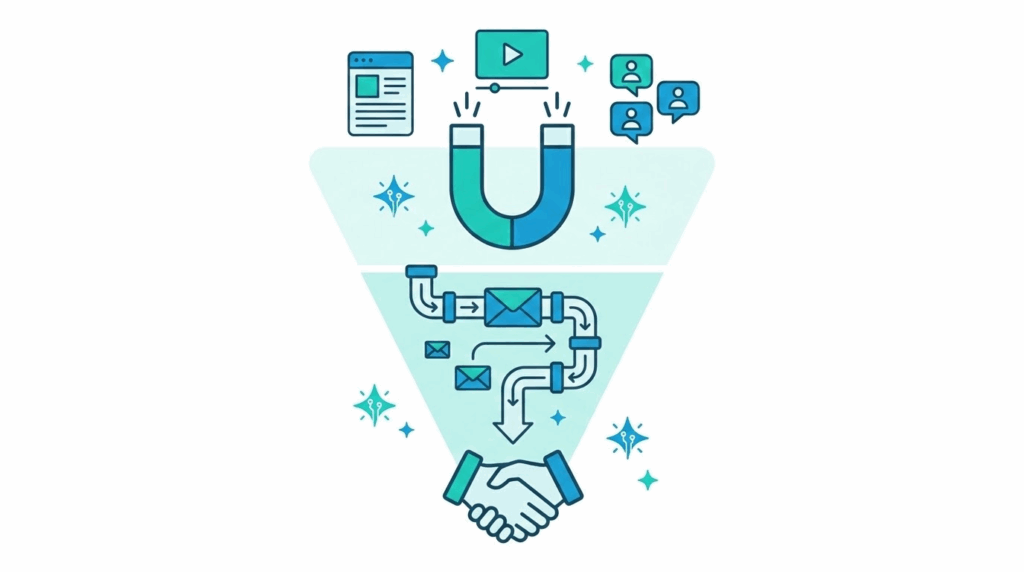
Inbound marketing is the opposite of cold outreach. Instead of chasing prospects, you attract them by creating content that answers their questions, solves their problems, and builds trust before they ever talk to your sales team.
Think about how you buy things yourself. When was the last time you responded to a cold call? Now think about the last time you Googled a problem, found a helpful article, and eventually bought from that company. That’s inbound.
For Singapore SMEs, this matters for a practical reason: you can’t outspend the big players on ads. A hospitality brand competing against Marriott’s ad budget? Forget it. But you can outteach them. You can create content that speaks directly to your niche — say, F&B operators looking to digitise their booking systems — and show up in search results where the big chains don’t bother competing.
The traditional inbound playbook has seven stages: Attract (content, SEO, social media), Engage (lead nurturing, CRM integration), Delight (customer support, loyalty), Lifecycle Management, Personalisation, Data-Driven Insights, and Sales Alignment. These stages haven’t changed. What’s changed is that AI now handles the parts that used to require a team of five.
How AI Is Changing the Game for Small Marketing Teams
Two years ago, running a proper inbound marketing operation meant you needed a content writer, an SEO specialist, someone managing email automation, a designer for social assets, and an analytics person reviewing performance weekly. For most SMEs? That’s the entire company.
AI has compressed that. Not perfectly, and not without human judgment. But meaningfully.
Here’s what’s actually different now:
Content Creation That Doesn’t Take All Week
The biggest bottleneck for SME marketing has always been content. You know you should be blogging, posting on LinkedIn, sending newsletters. But who has the time when you’re also closing deals and managing operations?
AI tools like ChatGPT can draft blog posts, social captions, and email sequences in minutes instead of hours. GenSpark can research your industry and surface insights you’d spend half a day finding manually. NanoBanana speeds up the creation process even further for rapid content production.
The key word here is “draft.” These tools don’t replace your expertise — they give you a starting point. A hospitality SME owner who knows the industry inside-out can take an AI draft and shape it into something genuinely useful in 20 minutes. Without AI, that same post takes three hours to write from scratch. That’s the difference between publishing twice a week and publishing twice a quarter.
Video Without a Production Budget
Google Veo 3 and similar AI video tools have made it possible to create marketing videos without hiring a videographer. For Singapore SMEs, where video content outperforms static posts on almost every platform, this is a big deal. You can now produce explainer videos, customer testimonial summaries, and product walkthroughs using AI-generated visuals and voiceovers.
Is it as polished as a $10,000 production? No. Is it ten times better than posting nothing? Absolutely.
Automated Follow-Up That Actually Feels Personal
This is where most SMEs lose leads. Someone downloads your guide or fills out your contact form, and then… nothing happens for three days because your team was busy.
AI-powered CRM and workflow automation tools fix this. You can set up email sequences that trigger automatically based on what a prospect did — visited your pricing page, downloaded a resource, attended a webinar. Each email adapts to their behaviour. The prospect who looked at your pricing three times gets a different follow-up than the one who just read your blog once.
Platforms like Engages.ai can run these workflows out of the box, with built-in email automation, pipeline tracking, and lead nurturing all in one place. The setup takes a day. Once it’s running, your leads get nurtured 24/7 while you focus on the ones ready to buy.
Smarter Lead Scoring
Not every lead is worth your time. AI can score leads based on their engagement patterns — how many pages they visited, which content they consumed, whether they opened your emails. Your sales team sees a ranked list of who’s most likely to convert, instead of guessing based on gut feel.
For a small team, this means the difference between spending an hour calling ten cold leads and spending that same hour on the two who are actually ready to talk.
What This Looks Like in Practice: A Singapore SME Example
Let’s say you run a hospitality training consultancy. Your target clients are hotel and F&B operators in Singapore who need to upskill their teams.
Without AI inbound marketing: You attend networking events, hand out name cards, follow up manually, maybe post on LinkedIn once a month when you remember. Leads trickle in through referrals. Growth is slow and unpredictable.
With AI inbound marketing:
You publish two blog posts a month — one about industry challenges (“Why Singapore hotels are losing repeat guests — and what to do about it”), one about practical solutions (“5 AI tools every F&B manager should know in 2026”). AI helps you draft and optimise these in half the time.
Each post has a call-to-action offering a free resource — a checklist, a template, a short guide. When someone downloads it, they automatically enter an email sequence. The first email delivers the resource. The second, two days later, shares a relevant case study. The third, a week later, invites them to a free consultation.
Meanwhile, your CRM tracks who opened what, who clicked through, who visited your services page. By the time a lead books a call, you already know what they care about. The conversation starts at a completely different level.
That’s the system. AI doesn’t replace the human work — your industry knowledge, your relationships, your ability to close. It handles the repetitive parts so you can focus where you actually add value.
The Tools That Make This Work
You don’t need an enterprise budget. Here’s a practical stack for a Singapore SME:
For content creation: Claude (writing and ideation), GenSpark (research and insights), NanoBanana (rapid content production), Google Veo 3 (AI video)
For email and automation: Engages.ai (email campaigns, automated follow-ups, pipeline management, and engagement tracking — all in one platform)
For CRM and lead management: Engages.ai handles this too — contact records, lead scoring, customer interaction tracking, and opportunity management without needing a separate CRM tool
For analytics: Google Analytics (user behaviour on your website), plus Engages.ai’s built-in dashboards for email open rates, pipeline metrics, and conversion tracking
For social media: Content planners with Content AI and Image AI capabilities for scheduling and creating platform-specific posts
The total cost for most of these tools? Under $200/month for an SME. Some are free. And if you’re a Singaporean business, government grants through the Productivity Solutions Grant (PSG) can subsidise up to 50% of qualifying digital marketing tools.
Why Singapore SMEs Have an Unfair Advantage Right Now
Singapore’s government has been investing heavily in AI education and digital transformation through initiatives like Smart Nation. That means SMEs here have access to training subsidies that businesses in most other countries don’t.
Through SkillsFuture, Singaporeans can access AI and digital marketing courses with subsidies of 50% to 70% (and up to 90% for those aged 40 and above through the Mid-Career Enhanced Subsidy). UTAP funding through NTUC gives union members an additional $500/year offset. And SkillsFuture Credits can cover whatever remains.
This means a three-day inbound marketing with AI course that costs $1,200 could end up costing as little as $0 out of pocket for eligible Singaporeans — after combining SSG subsidies with SkillsFuture Credits.
That’s a real advantage. The skills gap in AI marketing isn’t about access to tools (most are free or cheap). It’s about knowing how to use them strategically — mapping customer journeys, building automated workflows, creating content that actually attracts the right audience. That’s what proper training gives you.
Common Mistakes SMEs Make with AI Marketing
A few patterns we see repeatedly:
Using AI to create more noise, not better signal. Pumping out ten blog posts a week that say nothing useful doesn’t work. One genuinely helpful article per week that answers a real question your audience has will outperform mass-produced content every time.
Skipping the strategy. AI tools are only as good as your plan. If you don’t know who your buyer is, what their journey looks like, and what content they need at each stage, all the AI in the world won’t help. Build your buyer personas and customer journey maps first.
Forgetting the human element. The “AI” in AI-powered inbound marketing is a tool, not a replacement for your voice and your relationships. The most effective SMEs use AI for the 80% that’s repetitive (drafting, scheduling, data analysis) and keep humans for the 20% that matters most (relationship building, strategic decisions, creative direction).
Not tracking what works. If you’re not measuring which content generates leads, which emails get opened, and which channels drive conversions, you’re flying blind. Set up your analytics on day one.
How to Get Started This Week
You don’t need to build the whole system at once. Start here:
Step 1: Pick one buyer persona — your most common customer type. Write down their biggest challenge and the question they’d type into Google about it.
Step 2: Create one piece of content that answers that question better than anything else on page one. Use AI to help draft it, then add your own expertise and examples.
Step 3: Add a call-to-action to that content — a free download, a consultation, an audit. Something that captures their email.
Step 4: Set up a three-email follow-up sequence. Deliver the resource, share a case study, invite them to talk.
Step 5: Measure what happens. Who downloaded? Who opened the emails? Who booked a call?
That’s a minimum viable inbound system. It takes a weekend to set up. And once it’s running, it works while you sleep.
Want to Learn the Full System?
If you’re serious about building AI-powered inbound marketing capabilities for your SME or team, QD Academy runs a three-day intensive course: Developing Effective Inbound Marketing Strategies with AI.
The course covers the full 7-stage inbound marketing framework — from buyer persona development through to AI-automated workflows and performance analytics. You’ll get hands-on with real tools: ChatGPT for content, Google Veo 3 for video, GenSpark for research, NanoBanana for rapid production, and Engages.ai for CRM and marketing automation.
It’s taught by Koh Kang Liang, a startup founder turned digital transformation consultant who’s spent 10+ years helping SMEs build marketing systems that actually scale — without creating vendor dependency. His approach: build your team’s internal capabilities so you don’t need to keep paying an agency.
The next run is 11-13 March 2026. Course fee is $1,200, but with SSG subsidies (50-70%), SkillsFuture Credits, and UTAP, eligible Singaporeans can reduce the out-of-pocket cost dramatically — in many cases to zero.
Slots are limited. Register here or WhatsApp +65 8069 3194 (text only) if you have questions.
FAQ
What is inbound marketing?
Inbound marketing is a strategy that attracts customers through valuable content, SEO, and social media rather than interrupting them with cold calls or ads. It aligns your brand with the buyer’s journey by providing the right information at the right time, building trust before any sales conversation happens.
How can AI help with inbound marketing for SMEs?
AI automates the time-consuming parts of inbound marketing — content drafting, email follow-ups, lead scoring, and analytics. This means a small team of two or three people can run marketing systems that previously required a dedicated department. AI also enables personalisation at scale, adapting messages based on each prospect’s behaviour.
Is inbound marketing effective for small businesses in Singapore?
Yes. Singapore’s digital-first environment means most buyers research online before making purchasing decisions. Inbound marketing lets SMEs compete on expertise rather than ad spend. With government subsidies for digital tools (PSG) and training (SkillsFuture), the barrier to entry is lower than in most markets.
What AI tools are used for inbound marketing?
Common tools include ChatGPT (content creation), Google Veo 3 (AI video), GenSpark (research), NanoBanana (rapid content), Engages.ai (CRM, email automation, and engagement tracking in one platform), and Google Analytics (performance tracking). Many have free tiers suitable for SMEs.
How much does it cost to start AI-powered inbound marketing?
The tools themselves can cost under $200/month, with many offering free tiers. Singapore SMEs can access PSG grants to subsidise digital tools up to 50%. For training, SkillsFuture subsidies cover 50-90% of course fees for eligible Singaporeans, making professional AI marketing training highly accessible.
What is the difference between inbound and outbound marketing?
Outbound marketing pushes messages to prospects through cold calls, ads, and direct mail. Inbound marketing pulls prospects in through content they’re already searching for — blog posts, SEO, social media, and educational resources. Inbound typically costs less per lead and generates higher-quality prospects because they’ve already shown interest in your topic.