
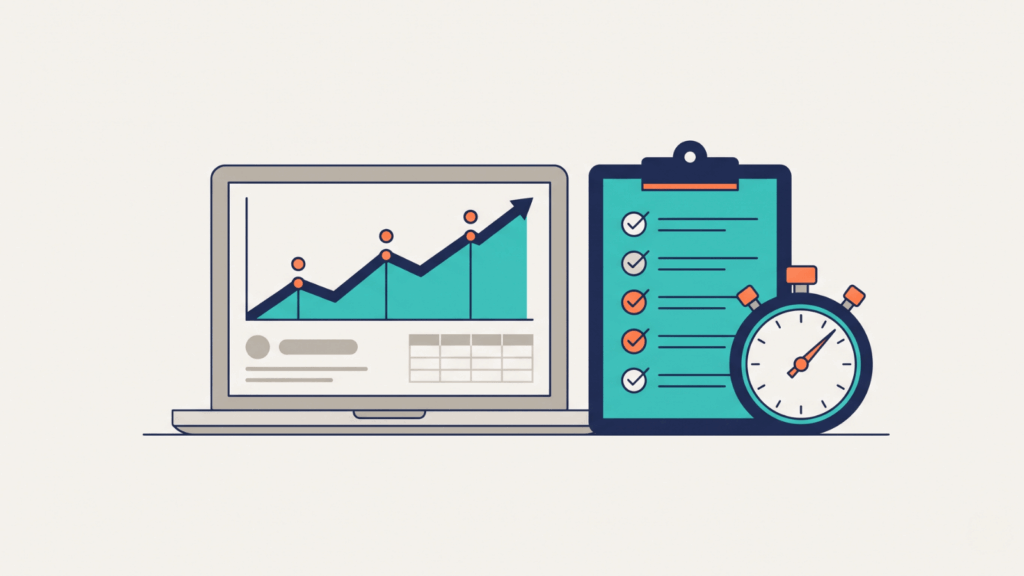
Many companies judge AI training by whether the room was full and the feedback forms were warm. Those tell you the class went well. They do not tell you whether anyone works differently the following month, and that is what the training was bought for.
This guide sets out how to measure whether AI training worked, with measures you can collect without special software. It follows from our guide to planning a corporate AI training programme, where Step 8 is to measure what changed.
Decide what success looks like before the class
Measurement starts before the training. Name the tasks you expect to change, and record how they are done today. Without a starting point, any improvement you see afterwards is a guess. Pick one or two tasks per team, such as the time to produce a weekly report, the number of follow-ups sent each week, or how many rounds of editing a proposal needs.
Three levels of measurement
Each level answers a different question, and each is easier to collect than the next.
| Level | Question | Examples of evidence |
|---|---|---|
| Use | Are people using what they learned? | Share of the team using AI on the named tasks each week, prompts or agents shared in a team folder |
| Task results | Did the work get faster or better? | Time per task, error or rework rate, response time to customers, quality scores from a manager’s review |
| Business results | Did it change an outcome the business cares about? | Leads followed up, deals progressed, hours released for other work, customer satisfaction |
Start with use and task results. Business results move more slowly and have many causes, so treat them as supporting evidence and avoid claiming the training alone produced them.
When to check
Check in three moments. A week after the class, ask whether people have tried the skill on real work and what stopped them. At about a month, measure use and the time taken on your named tasks. At two to three months, review task results again and decide whether to extend the training to other teams. A short, regular check-in with the team lead works better than a long survey at the end.
A simple calculation
To put a figure on the return, estimate the value of time saved and compare it with the cost. The cost is the net course fee after subsidies, plus the working time people spent attending. The saving is the hours recovered each week multiplied by the cost of an hour of that person’s time. As an illustration only, if ten people each recover one hour a week, that is ten hours a week, or about five hundred hours over a year. Keep your own assumptions conservative and write them down, so the figure can be checked.
Funding changes the cost side. Employers can use schemes such as Absentee Payroll funding and the SkillsFuture Enterprise Credit (SFEC) on eligible courses, and the conditions for each scheme are set out in our employer funding guide.
Common mistakes
- Measuring attendance and satisfaction only. These show the class was liked, and say nothing about changes in work.
- Picking measures after the training. Results chosen afterwards tend to flatter the programme.
- Counting every hour as saved. Time saved on one task is often spent checking AI output, so count the net saving.
- Ignoring quality. A faster task with more errors is not an improvement. Track a quality measure next to every time measure.
- Waiting too long. Habits form or fade within weeks, and an early check lets you help people who are stuck.
What the course provider can contribute
Ask the provider what they track and share. Learner surveys on MySkillsFuture, run under TRAQOM, collect feedback on course quality and on the effect of training on jobs and careers. Use that as one input and add your own measures, because only you know which tasks matter to your business.
Your next step
Before you book training, choose the tasks and the measures, and record the starting point. If you want help turning that into a plan for your team, message our team on WhatsApp at +65 8069 3194. We will suggest a format and check which funding applies, and you can estimate a subsidy with the grant calculator on our Grants and Subsidies page. The AI for Sales course is an example of a course with clear task outcomes to measure, and our guide to funding for AI and skills training covers every scheme.
Frequently Asked Questions
How do you measure whether AI training worked?
Record how named tasks are done before the training, then check use of the new skills and results on those tasks a week, a month and two to three months afterwards. Pair every time measure with a quality measure.
What is a good measure of AI training ROI?
Net hours recovered on specific tasks, multiplied by the cost of that time, compared with the net course fee and the working time spent attending. Keep the assumptions conservative and written down.
How soon should we see results from AI training?
Use and early task results can show within a few weeks if people apply the skills to tasks they repeat every week. Business outcomes take longer and depend on many other factors.
Should we survey staff after AI training?
Yes, briefly. Ask whether they have used the skills, what got in the way and which task they would tackle next. Combine the answers with task measures rather than relying on the survey alone.
Can funding change the return on AI training?
It lowers the net cost. Employers may be able to use schemes such as Absentee Payroll funding and SFEC on eligible courses, so check the conditions in our employer funding guide before you register.