
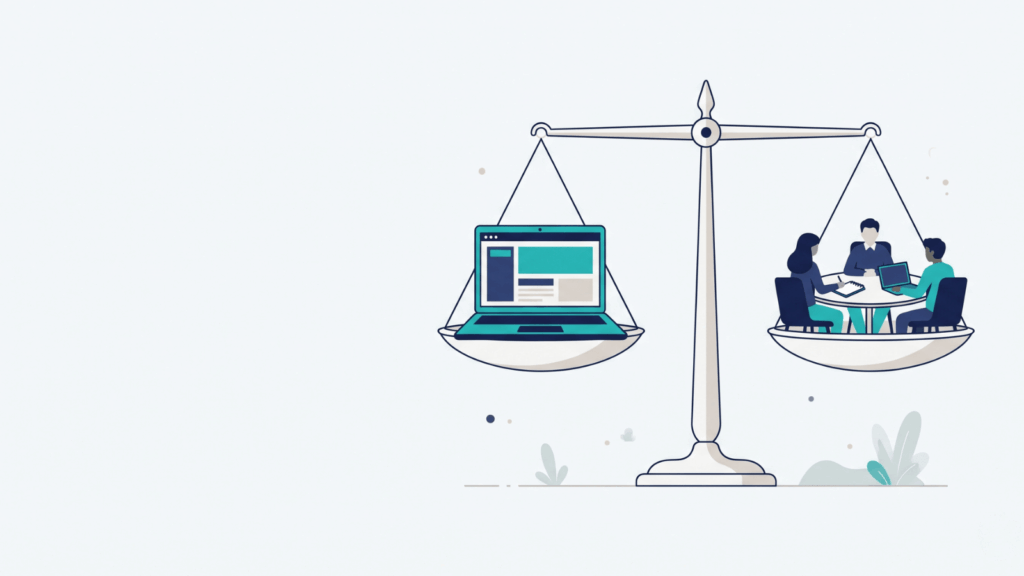
Whether an AI course is worth it depends on what you plan to do the week after. A course that sits unused costs you the fee and the days away from work. A course that changes one weekly task can repay both within a few months. Free videos and tutorials are enough for some people, and a course is the better route for others.
This guide helps you decide which group you are in, what a good course delivers, and how funding changes the sums for Singapore learners.
When self-study is enough
Self-study works well when the goal is narrow and you can check the result yourself. Examples include learning how to write better prompts for an assistant you already use, trying a new tool on a personal task, or getting a first feel for what AI can and cannot do. A few evenings of free material and regular practice will take you a long way.
It also suits people who are disciplined about practice. If you will schedule an hour a week to try things on real work, the lack of a class is not a problem.
When a course pays off
A course earns its fee in situations where self-study tends to stall.
- You need a result, not general knowledge. If the aim is to automate a real process or change how a team sells or serves customers, a trainer who has done it before saves weeks of trial and error.
- You need feedback. A trainer can see that a prompt works by luck, or that an agent will break on the second invoice. Videos cannot.
- A team must change together. Everyone learning the same method at the same time creates a shared habit, which individual study rarely does.
- You keep putting it off. A booked class with a date and a deadline is accountability that free material does not provide.
- Funding lowers the cost. Many courses carry government subsidies, so the net fee can be a fraction of the full fee. Check the fee breakdown first, and see our guide to funding for AI and skills training.
A simple way to test the return
Pick one task that you or your team repeat each week, and estimate how long it takes now. Then estimate how much of that time AI could realistically save once you know how to use it well. As an illustration only, if a task takes three hours a week and AI cuts it by a third, you recover one hour a week, which is about fifty hours in a year. Compare that with the net fee and the days of work you will give up, and decide whether the trade makes sense for you.
Be conservative with the saving. Quality checks take time, and the first weeks are slower while you learn.
What a good course should deliver
- A working output you built yourself, such as an automation, a journey map or a sales workflow.
- Practice on tasks from your own job, with a trainer who gives feedback.
- A clear fee breakdown and a course reference number you can look up on MySkillsFuture.
- A trainer who has used these methods in a business, not only in a classroom.
Our guide on how to choose an AI training provider in Singapore lists the questions to ask before you pay.
What to expect from a short course
A one-day or two-day course will not make you an AI expert. It should give you a method, a first working result and the confidence to keep going alone. Learners who do well are usually the ones who apply a skill to real work within the first week and keep notes on what worked. Plan that time before you enrol.
Your next step
If you are weighing a course, write down the task you want to change and message our team on WhatsApp at +65 8069 3194. We will tell you whether a course would help or whether self-study is enough, and check what funding applies. You can also work out your subsidy with the grant calculator on our Grants and Subsidies page. The AI-Powered Productivity course is a one-day way to test the idea, and our guide to AI courses for beginners explains where to start.
Frequently Asked Questions
Is an AI course worth it for working professionals in Singapore?
It is worth it when you will apply the skill to real work soon after the class and the net fee, after any subsidy, is small compared with the time you expect to save. A course is also useful if you need feedback and accountability that self-study does not give.
Can I learn AI on my own instead of taking a course?
Yes, for narrow goals such as learning a tool or improving your prompts. Courses add the most when you need a working result, feedback from an experienced trainer, or a whole team to change together.
How long does it take to see a return from an AI course?
It depends on how quickly you apply it. Many people notice time savings within a few weeks if they use the new skill on a task they repeat each week, and the saving grows as the skill becomes habit.
Are AI courses in Singapore subsidised?
Many are. Funding depends on the course and on who you are, so check the fee breakdown on the MySkillsFuture course page and ask the provider for a written breakdown before you pay. See our guide to checking whether a course is funded.
What should I look for in a good AI course?
Look for hands-on practice on your own tasks, a trainer with business experience, a clear fee breakdown and a result you can use at work the next week.